Why the Church holds the ever-virginity
The Orthodox Church has rules about what may be painted in an icon. They were stated by its own councils and its own teachers, and they are not hard to understand: God the Father may not be painted as an old man, because no one has seen Him; the Holy Spirit may be painted as a dove only at the Baptism, where He appeared in that form; a saint may not be painted with an animal’s head. The rules are clear. The practice breaks them, openly, and has done for centuries. The Church’s own theologians say so.
That is the verdict. What follows is the evidence for it: the rule as the Church itself states it, what Scripture says, the cases tested one by one against the rule, and what the people actually venerate.
1. The rule — what the Church itself says may be depicted
The rule rests on the Incarnation. John of Damascus, the great defender of icons, stated it in the eighth century: “Of old, God the incorporeal and uncircumscribed was never depicted. Now, however, when God is seen clothed in flesh, and conversing with men, I make an image of the God whom I see.” The point cuts both ways, and Damascene states the other edge of it himself: “But besides this who can make an imitation of the invisible, incorporeal, uncircumscribed, formless God? Therefore to give form to the Deity is the height of folly and impiety.” What was seen in the flesh may be depicted. What was not seen may not.
The Seventh Ecumenical Council, Nicaea II (787), authorised icons “of our Lord God and Saviour Jesus Christ, of our spotless Lady, the Mother of God, of the honourable Angels, of all Saints and of all pious people,” on the ground that the Incarnation is shown “as real and not merely phantastic.” Two honest limits belong here, and this piece states them plainly. First, Nicaea II issued no canon in so many words banning a portrait of the Father. The ban follows from the principle — the criterion for depicting the Godhead was His visible incarnation — and the iconophile Fathers stated it, but the council itself did not spell it out. Second, the explicit bans come later, and from local councils, not ecumenical ones. The criticism in this piece is stronger for saying so, because it does not need to overstate the record: the Church’s own teachers drew the conclusion from the council’s principle, and the Church’s own synods then wrote it down.
One canon shows the Church could enforce such a rule when it chose. Canon 82 of the Quinisext Council (692) forbids depicting Christ as a lamb: since the true Lamb has come in human flesh, Christ is to be painted “according to the human character,” not as the animal type. The East largely obeyed. The lamb was replaced — by the Christ-child on the diskos, by John the Baptist holding the child in a chalice instead of pointing at a sheep. Where the Church meant its rule, the pictures changed. Remember that when the cases below are tested.
The explicit bans on painting the Father come from Russia. The Great Council of Moscow (1666–67), in its Tome, chapter 2, paragraphs 43 to 45, ordains that “the icon of the Lord Savaoth not in future be painted in absurd and improper aspects, because no one has at any time seen Lord Savaoth in the flesh,” and condemns by exact description the icon of “the Lord Savaoth (that is to say, God the Father) with a grey beard and the Only-Begotten Son in His bosom with a dove between them.” The council gives its reasons from Scripture — John 6:46, Isaiah 40:18–19, Acts 17:29 — and from Damascene. It also rules that the Holy Spirit may be represented as a dove “in this context only”: at the Baptism, where He appeared in that form. The Russian Synod of 1722 repeated the ban: it is “strictly forbidden to represent the Lord Sabaoth in the form of an old man.” And in 1776 the Holy Synod of Constantinople declared that “the icon allegedly of the Trinity is an innovation. It is alien to the apostolic Orthodox Catholic Church and is not accepted by it. It infiltrated the Church through the Latins.” So the objection is not Russia’s alone.
Fr Steven Bigham, an Orthodox priest who wrote the standard study of this question, sums up the position: “Church tradition clearly states that the Incarnation is the only basis on which a portrait of the invisible God can be painted, and yet icons of the Father and the Trinity abound in Orthodox Churches… it is forbidden to make a direct representation, an icon, of the person of the Father.” The St Elisabeth Convent in Minsk, which publishes on iconography for the Church, puts the deeper reason plainly: the Son is the Father’s natural image, and “the Son entirely and completely exhausts in Himself the iconicity of the Father, so that there is no way that another image of the Father could exist alongside of and in addition to the Son.”
That is the rule, at its strongest, from the Church’s own sources. Now the test.
2. What Scripture says
Scripture’s statements are short and repeated. “No one has ever seen God; God the only Son, who is at the Father’s side, he has made him known” (John 1:18). Jesus says the same of the Father: “not that anyone has seen the Father except he who is from God; he has seen the Father” (John 6:46). To Moses God said, “you cannot see my face, for man shall not see me and live” (Exodus 33:20). Paul describes God as the one “who alone has immortality, who dwells in unapproachable light, whom no one has ever seen or can see” (1 Timothy 6:16). And Isaiah asks the question the whole question turns on: “To whom then will you liken God, or what likeness compare with him?” (Isaiah 40:18).
Scripture also says who the Father’s image is. “He is the image of the invisible God” (Colossians 1:15) — of Christ. And when Philip asked to be shown the Father, Jesus answered: “Whoever has seen me has seen the Father. How can you say, ‘Show us the Father’?” (John 14:9). The Son is the one visible image of the invisible God. That is Damascene’s principle, and it is Scripture’s.
The one text cited for painting the Father as an old man is Daniel’s vision: “As I looked, thrones were placed, and the Ancient of Days took his seat; his clothing was white as snow, and the hair of his head like pure wool” (Daniel 7:9). It should be stated fairly: Daniel saw a vision, and the vision describes white hair. The question is what a vision’s imagery licenses. The same chapter shows “one like a son of man” coming with the clouds — vision language, not a portrait sitting. The Moscow council read the Ancient of Days as the Son at His second coming, come to judge; Cyril of Alexandria is reported to have identified the Son of Man with the Ancient of Days. The Greek painters’ manuals took the other road, instructing the painter to depict the Unoriginate Father in the form of an Elder, as Daniel saw him. A vision in which God appears in a form is one thing. A portrait of the Father as an elderly man, painted from no one’s sight of Him, is another. John 1:18 does not say “no one has ever seen God, except in visions, whose imagery may then be painted.” It says no one has ever seen God, and the Son has made Him known.
3. The cases, tested
The New Testament Trinity — God the Father as an old man. This is the type Moscow condemned by description: the Father as a grey-bearded old man, the Son beside or before Him, the dove between them. Here it is, painted in Constantinople about 1450, most likely for a church iconostasis:
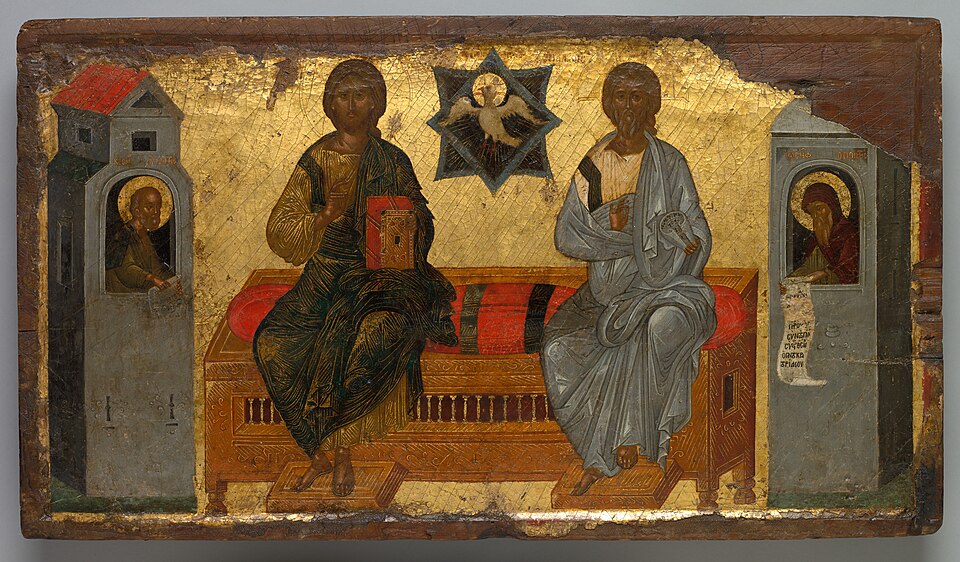
The type has two main forms. In the older “Paternity” form, found in Greek art from the eleventh century, the Father sits enthroned as an old man with the Son as a child on His knees and the dove between them. In the “Soprestolie” form, which became the norm after 1453 under Western influence, the Father and the adult Son sit side by side on one throne, as in the Cleveland icon. There is also a reduced form: the Father and the dove added at the top of an icon of something else — above a Crucifixion, or above the Mother of God holding the Christ Child.
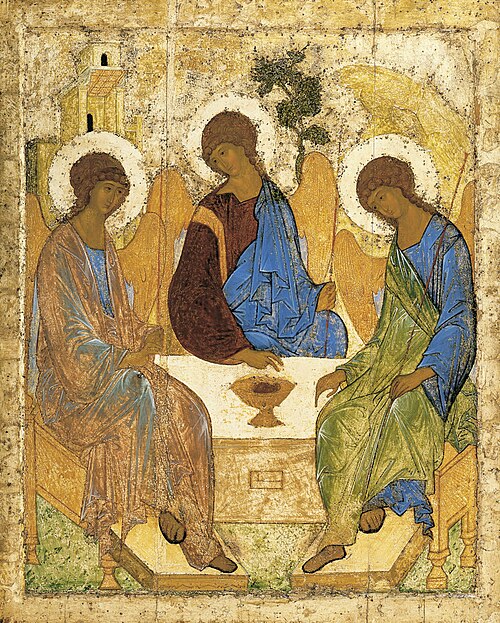
Against this stands the one Trinitarian icon the Church’s tradition approves: Andrei Rublev’s Trinity, the three angels who visited Abraham at Mamre (Genesis 18). The Stoglav Synod of 1551 allowed it precisely because the three faces are symbolic — the icon is inscribed only “Holy Trinity” and does not assign a particular person to any angel, still less paint the Father as an old man.
The condemned type did not die. It survives in the most venerated place possible: at the top of the Kursk Root Icon, one of the main icons of the Russian Church Abroad, which incorporates “the Lord Sabaoth above them (with the Holy Spirit as a dove)” above the Mother of God and the Christ Child. The icon is carried to parishes and venerated in canonical Orthodoxy today. Antique New Testament Trinity icons, painted in Ukraine in the nineteenth and twentieth centuries — two and three hundred years after the ban — are still bought and sold, and new ones are produced and marketed as Orthodox.
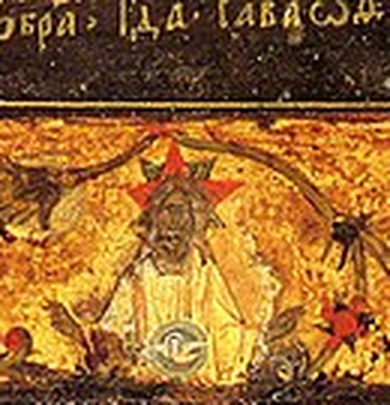
Nor is the type only Russian. On Mount Athos itself, on the boss of the ceiling of the entrance porch of Vatopedi Monastery, the New Testament Trinity is painted in fresco: Christ with the cross, God the Father as a white-bearded old man with a triangular halo, and the dove above between them, inscribed “The Holy Trinity.” Vatopedi’s own media outlet, Pemptousia, dates the porch decoration to 1858, names the painter — the monk Nikiphoros — and calls the ceiling image “an imposing Western-style Holy Trinity.” That is 191 years after Moscow condemned the type by exact description, and 82 years after Constantinople called the Trinity icon an innovation. The fresco is still in place.
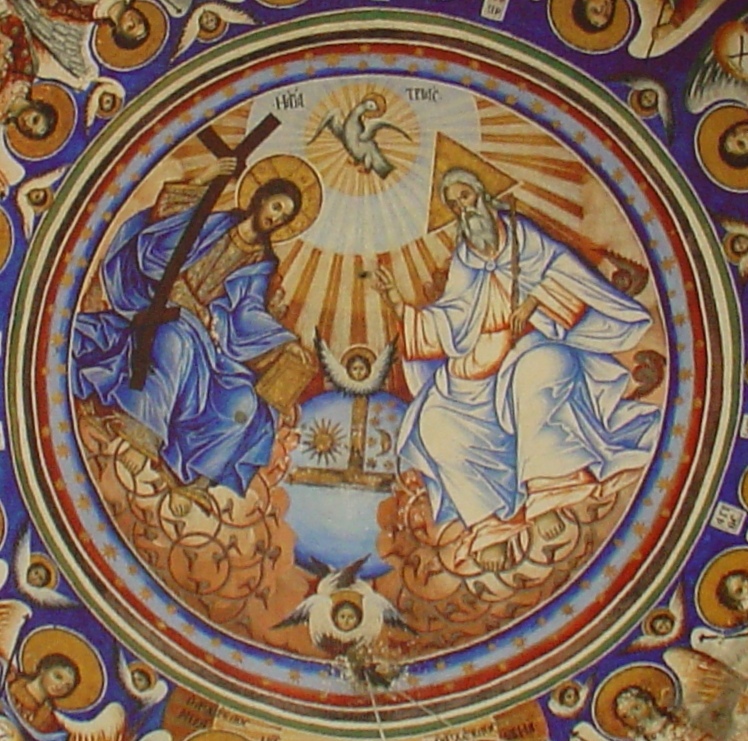
The Greek painters who painted such images were not breaking their own book. The standard Greek painters’ manual, the Hermeneia compiled by Dionysius of Fourna on Mount Athos in 1730–1734, tells the painter how to paint the Father: appearing to the waist and looking down, with the Holy Spirit coming forth as a dove, for the Creed’s article on the Holy Spirit (§147); appearing in the heavens with a multitude of angels at the Baptism (§149); and on clouds, radiating light, for “Our Father who art in heaven” (§152). The strict manual tradition itself prescribes what the councils condemned. And St Nicodemus of the Holy Mountain, the great Greek canonist, is reported to argue in his commentary in The Rudder that the Father ought to be painted as He appeared to Daniel as the Ancient of Days — the Greek authorities defended the type, against the Russian conciliar line.
Two honest qualifications. First, an old white-haired figure in an icon is sometimes claimed to be Christ, not the Father — the Novgorod type called “Saviour Old with Days” paints Christ himself as an old man. The St Elisabeth Convent notes that “Old Man” icons “are often claimed to be images of the Father and often claimed to be something else.” That ambiguity is itself part of the problem: a figure nobody can identify without argument is being venerated either way. Second, official Russian Orthodoxy today largely does not paint the type; it survives in older church decoration, in non-Russian practice, among Old Believers, and in the Kursk icon. But “largely” is the evasion in one word. The ban was absolute. The practice is not.
The All-Seeing Eye. The Russian icon called “the All-Seeing Eye of God” is a complex allegorical picture from the nineteenth century, common in the Old Believer milieu: Christ Emmanuel at the centre, fragments of a human face — eyes, nose, mouth — around Him, the evangelists’ symbols, seraphim, and at the top God the Father blessing, with the Holy Spirit as a dove. Its proof-text is Psalm 33:18: “Behold, the eye of the Lord is on those who fear him, on those who hope in his steadfast love.” The verse is a metaphor of God’s providence — His eye is on those who fear Him. The icon turns the metaphor into a painted eye, a painted face, and a painted Father.
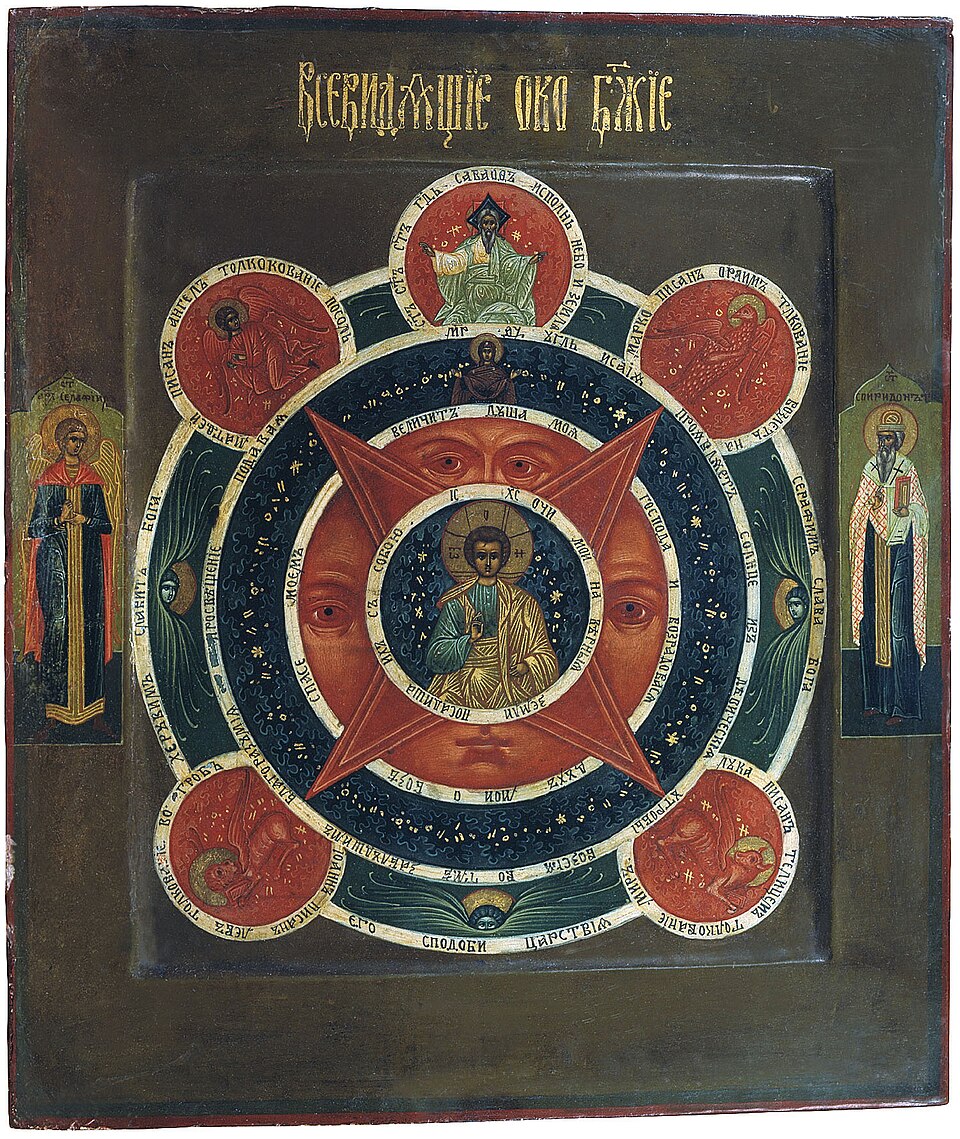
The conciliar trail against it is the longest of any case in this piece. On the St Elisabeth Convent’s account of the Stoglav Synod of 1551, “the All-Seeing Eye” was named among the prohibited images of the Father. Moscow in 1666–67 forbade painting Sabaoth in improper aspects because no one has seen Him in the flesh. The Synod of 1722 forbade Sabaoth as an old man. Constantinople in 1776 rejected the Trinity icon as a Latin innovation — that decree concerns the Trinity icon, not the Eye by name, and this piece states it precisely. In our own time, a Russian archpriest writing for the Tatarstan Metropolia in 2016 concluded that because the Eye icon contains an image of God the Father, forbidden by Moscow, it is not canonical; Metropolitan Hilarion has said that such icons are not canonical, correspond to no church text, and that believers should not pray before them.
The Greek manual prescribes the Eye too. For “Hallowed be thy name,” the Hermeneia (§153) instructs the painter to make “the unsleeping Eye of the Father,” with the cherubim, seraphim and the other ranks of angels around the Eye and the twelve Apostles glorifying below. Stoglav had banned the image in Russia in 1551; the Greek book, compiled on Athos nearly two centuries later, tells the painter to paint it. And Greek painters did. In the Greek church of St Haralambos at Çeşme in Asia Minor, built in 1830–1832 for the Greeks of the town, an Eye of Providence — an eye in a triangle with rays — is painted over the apse; the frescoes are by John Sitaras of Paros, trained at the Athens School of Fine Arts. The church is now a cultural centre, and the frescoes survive in place. That case is reported, from a 2016 symposium study of the church, and it is Asia Minor, not modern Greece: no named church in Greece itself with the Eye has been verified. The Greek warrant that is verified is the manual’s own instruction.
One correction belongs here, because the charge is often made wrongly. Orthodox sources do not say Freemasons invented this icon. They call it Western, Latin, German — an import. Freemasonry adopted the eye-in-triangle as a standard emblem only in 1797, after centuries of Christian use; the Masonic use is a parallel adoption, not the source of the Russian icon. The Orthodox objection is older and simpler: the icon paints what no one has seen, against the councils. It does not need a Masonic conspiracy to be wrong by the Church’s own rule.
The Holy Spirit as a dove, outside the Baptism. Moscow’s rule, stated in §1 above, is that the Spirit may be painted as a dove “in this context only” — at the Baptism, where He appeared in that form. The reasoning is sound, and Scripture is with it. At the Baptism, Matthew writes, Jesus “saw the Spirit of God descending like a dove and coming to rest on him” (Matthew 3:16) — a simile for one event, not a portrait of the Spirit’s nature. At Pentecost there is no dove at all: “a sound like a mighty rushing wind” and “divided tongues as of fire” (Acts 2:2–3). At the Annunciation, Gabriel promises that “the Holy Spirit will come upon you, and the power of the Most High will overshadow you” (Luke 1:35) — no dove, no form. The modern Greek iconographer Photios Kontoglou stated the limit in his own words: a dove painted alone and inscribed “The Holy Spirit” “would give the false impression that the Holy Spirit is a dove.”
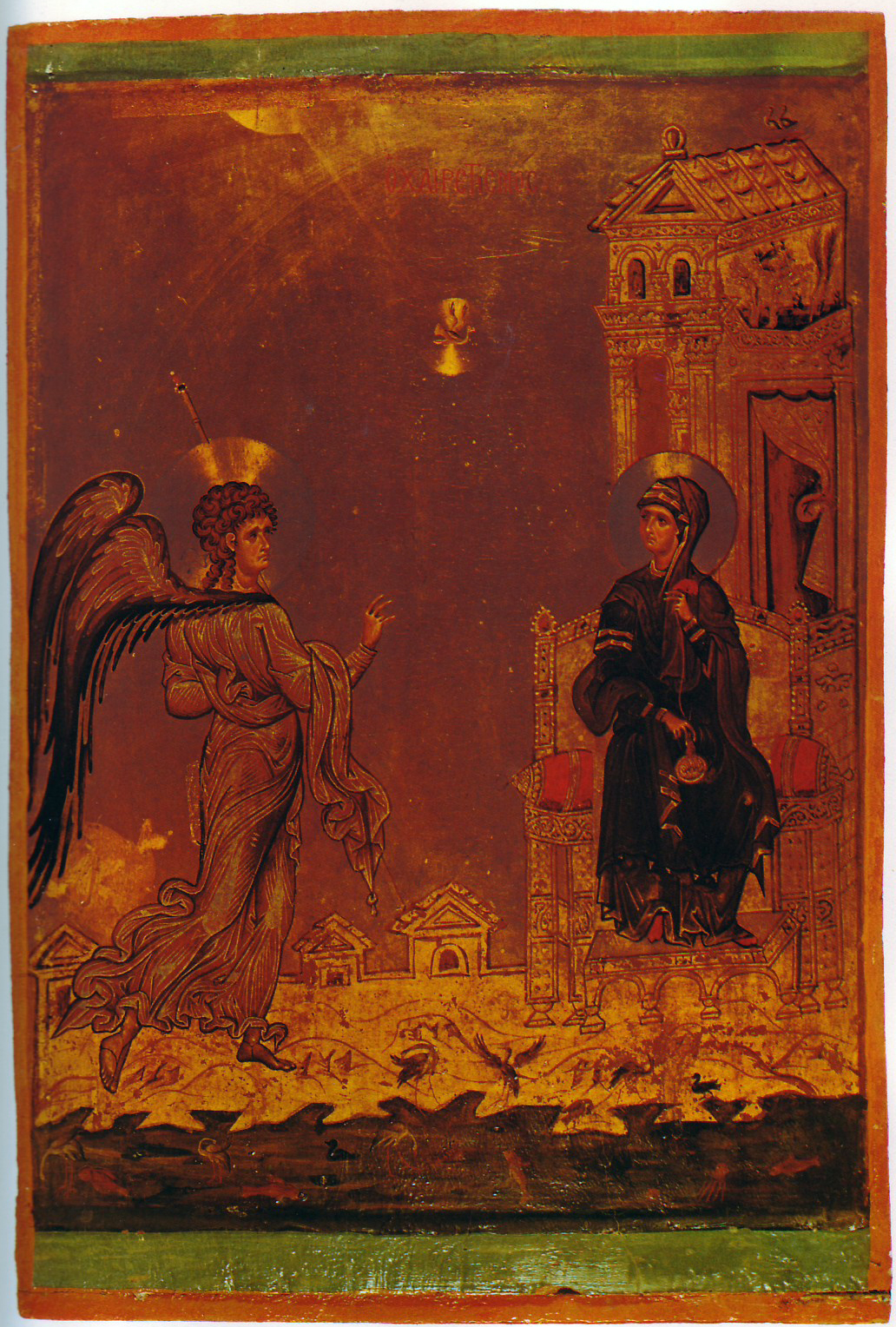
The practice never accepted the limit. The dove appears at Pentecost, as a recognised variant of the tongues-of-fire type. It appears at the Annunciation, as in the Sinai icon above, and the Annunciation-with-dove became the standard Cretan type in the fifteenth century, spreading through the sixteenth and seventeenth. And the Greek manual prescribes it: at Pentecost the Hermeneia (§147) tells the painter to make the Father appearing to the waist, looking down, “and the Holy Spirit coming forth as a dove”; at the Annunciation (§161) it tells him to paint heaven above the house, “and from it the Holy Spirit descending with a ray onto the head” of Mary — the dove is not named in that instruction, and Moscow’s own Annunciation decree (§45) targets a different variant, Sabaoth breathing from his mouth into Mary’s womb, not the dove on a ray. Those precisions belong in the record, and so does the limit of the rule itself: Moscow binds most clearly in the Russian tradition, and the Greek practice — the Sinai dove, the Cretan type — predates it and sits outside it. But the principle Moscow stated is not a Russian peculiarity; it is Kontoglou’s too, and it follows from Scripture’s own account. The Spirit descended like a dove, once, at the Jordan. The icons make the simile a standing portrait, and paint it where no dove appeared.
Barlaam and Josaphat — the Buddha in the calendar. Barlaam and Josaphat are venerated as saints: a hermit and the Indian prince he converted. The story is a Christianised life of Siddhartha Gautama, the Buddha. It travelled from Sanskrit through a Manichaean version into Arabic as the Book of Bilawhar and Budhasaf, then into Georgian, then into Greek in the eleventh century, where it was attributed to John of Damascus, and from Greek into Latin and the Golden Legend. The prince’s name gives it away: “Josaphat” derives from the Sanskrit bodhisattva — the Buddha’s title before his enlightenment. This is not an evangelical discovery. OrthodoxWiki, an Orthodox source, states it openly: “The Greek legend of ‘Barlaam and Ioasaph’… was ultimately derived, through a variety of intermediate versions (Arabic and Georgian) from the life story of the Buddha.”
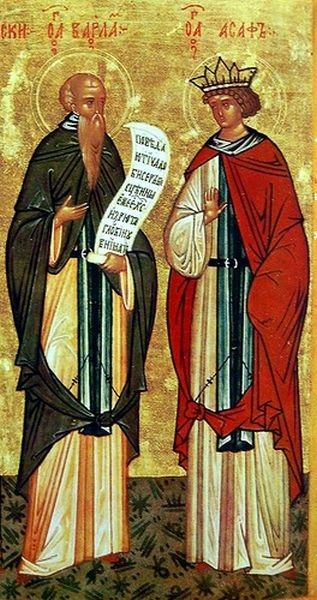
And there they remain. The Greek Orthodox calendar keeps them on 26 August — the Greek synaxarion still lists him as Joasaph, son of the king of India, Avenir; the Slavic calendar keeps them on 19 November. The Buddhist origin has been common scholarly knowledge since the nineteenth century. Rome removed legendary saints from its universal calendar in 1969; no Orthodox synod has done the same for these two. A church that commemorates the Buddha every year, under a Christianised name, in its own calendars and synaxaria, cannot plead that it does not know. Its own reference works say where the story came from. It keeps the feast anyway.
St Christopher with a dog’s head. In a body of icons from the seventeenth to the nineteenth centuries — Greece, Mount Athos, the Balkans, Russia — St Christopher is painted as a haloed man with the head of a dog, inscribed with his name. The type comes from the Eastern life of Reprobus, a dog-headed cannibal captured into the Roman army, baptised in Antioch and renamed Christophoros; the Greek Synaxarion of Nikodemos calls him “dog-faced… from the land of the man-eaters.” There is no Christopher, no Reprobus, and no dog-headed race in Scripture.
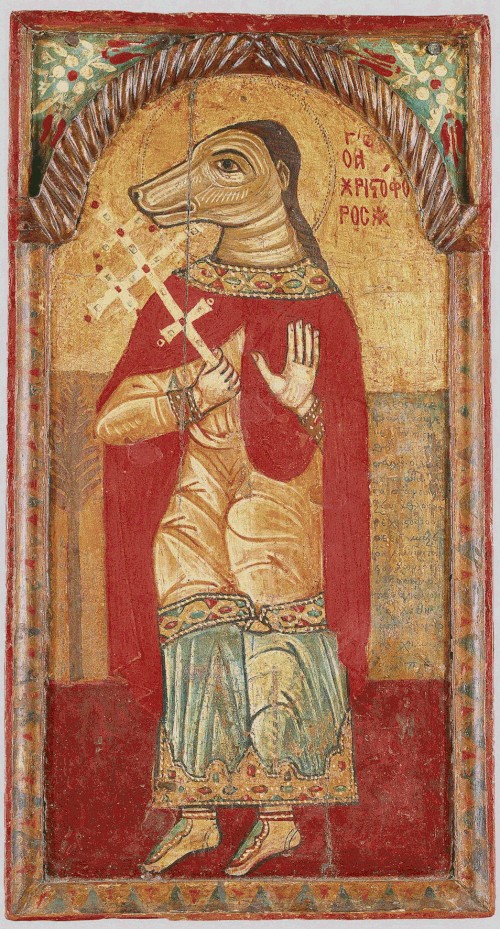
This type breaks something prior to any synod’s ban: the Church’s own strict iconographic tradition itself. That tradition is claimed as strict and unchanging, and the claim is not vague. The Greek painters’ manual, the Hermeneia, lays down the natural measures of the human figure in detail (§65): the man is nine measures from forehead to sole; the face divides into three — forehead, nose, chin; the ear must be as long as the nose; the waist is four noses wide. Everything is measured, everything has its fixed type, and the saint’s name is written beside the human face so that the one venerated is known. The Kermira icon follows that discipline in everything but the head: the name is written beside the figure, as the rule requires — beside a dog’s head. No received type of any saint has an animal’s head. The manual tradition that measures the nose and the ear has no measure for this, because there is no such type to measure. And yet the dog-headed Christopher was painted, on church walls and on Athos, and venerated, for centuries. The strictness stops applying where the people want the image.
The Russian Synod banned the type in 1722. The ban is attested by Orthodox sources themselves: the St Elisabeth Convent records that the icon “was later prohibited by the Synod of 1722 for being ‘contrary to nature, history, and the truth itself’”; a scholarly study of the iconography confirms that after the 1722 ban Christopher was painted with a human head, while the dog’s head continued among Old Believers; Jonathan Pageau, a contemporary Orthodox iconographer, notes that “the icon was proscribed in the 18th century by Moscow.” Two honest limits: the text of the 1722 decree itself has not been read for this piece — the ban is attested by the sources above, not quoted from the decree — and no Greek synodal ban has been found, so this was a Russian ban, not a pan-Orthodox one. Pageau also defends the image’s meaning — the foreigner at the edge of the world, saved — and his defence should be stated fairly; but he himself records the proscription, and one modern voice is not synodal approval.
The present state, on the Church’s own reporting, is this: new mainstream production has ceased — church-shop icons show a human head — while the historic dog-headed Christophers survive on church walls and in museums, and in Old Rite communities. This is the “banned and retired” case, and it is the best outcome in this piece. Even here, the retirement took three centuries, the banned image is still on the walls, and in Greece, where no synod banned it, it was painted in churches and on Athos into the eighteenth century. The Greek frescoes are documented: at Melies in Pelion, in the Taxiarches church on the central square — built in 1741, frescoed in 1774 — the dog-headed Christopher stands on the north wall, in military uniform with a long halberd, inscribed with his name; another is at the church of the Holy Unmercenaries at Androni. No photograph of these frescoes with a verified free licence exists, so they are named here in words only; the last scholarly sighting of the Melies fresco is 2011, and its present state is reported, not verified. But the dates are the point: in 1774, half a century after the Russian ban, Greek painters were still putting the dog’s head on the saint, in a Greek parish church, under the strict tradition that measures the nose and the ear.
The Three-Handed Mother of God. At Hilandar Monastery on Mount Athos, the most venerated icon is the Mother of God holding the Christ Child, covered with a silver riza, with a third hand in silver at the lower left. The monastery has no abbot; the Mother of God is its Abbess, and the icon is her throne. The tradition’s own account of the third hand is told by the Orthodox sources themselves: St John of Damascus, falsely accused of treason by a forged letter, had his right hand cut off by the caliph’s order — the caliph is named variously in the retellings, and the detail is the tradition’s, not established history; John prayed before an icon of the Mother of God, the hand was restored, and in thanksgiving he attached a silver replica of his hand to the icon. The third hand, on the tradition’s own telling, is not Mary’s hand. It is John’s votive offering. Art historians are reported to date the icon’s style to the fourteenth century, not the eighth the story requires; the tension is stated here because the sources state it.
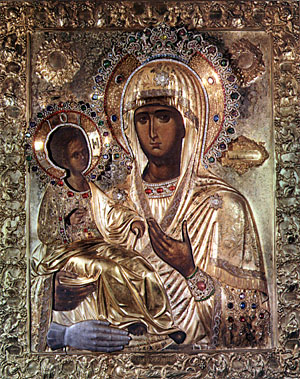
No synod has condemned this icon, and no Orthodox source criticises it; this piece does not invent a criticism that does not exist. The finding is different, and it is in the tradition’s own words. The hand is John’s, not Mary’s — and the icon is named, feasted and copied as “the Three-Handed Mother of God.” It has two feasts, 25 July and 11 July. Its copies are widespread and officially venerated, and in the painted copies the third hand is reported to be painted on, as if it were Mary’s own: the distinction the Hilandar original keeps — a silver hand visibly attached to a two-handed icon — is collapsed. Nicaea II authorised images of the Mother of God as memorials of the prototype, agreeing with the history of the Gospel. A painted three-handed Mary is not a memorial of the prototype; it depicts her with an anatomy she never had, and the tradition agrees she never had it. A votive offering became an icon’s name, its feasts, and its copied form — and nobody in the tradition has said a word against it. The absence of criticism is itself the finding.
Sophia, the Wisdom of God. The Novgorod type of this icon shows Holy Wisdom as a fiery, winged, crowned angel enthroned, flanked by the Mother of God and St Cosmas of Maiuma. A second type illustrates Proverbs 9:1, “Wisdom has built her house.” The central figure is ambiguous by design: is it Christ, the Holy Spirit, the Mother of God, or a distinct feminine person of God?
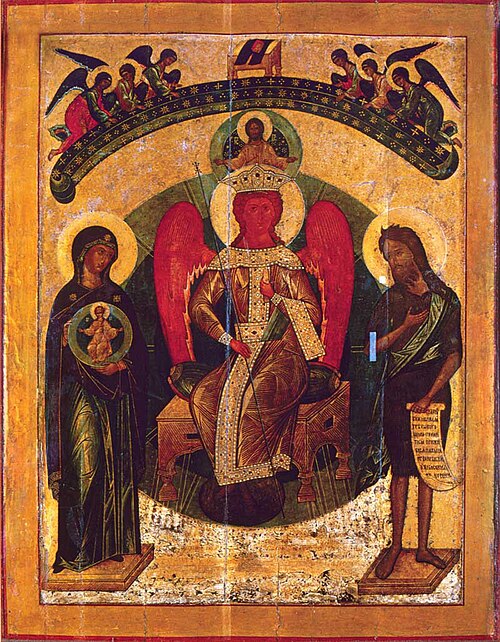
The Church’s own teaching is not ambiguous. The Acts of Nicaea II call Christ “our Lord Jesus Christ, our true God, the self-existent Wisdom of God the Father,” and Paul says the same: “Christ the power of God and the wisdom of God” (1 Corinthians 1:24). Wisdom is Christ, not a separate person. In 1935 two Orthodox jurisdictions condemned the theology that treats Sophia as a distinct divine person — the sophiology of Archpriest Sergei Bulgakov. The Moscow Patriarchate ruled that his teaching “is to be recognized as alien to the Holy Orthodox Church of Christ”; the Bishops’ Council of the Russian Church Abroad resolved “to recognize the teaching of Archpriest Sergei Bulgakov on Sophia the Wisdom of God as heretical.” Vladimir Lossky, the leading Orthodox theologian of the next generation, called sophiology “a misguided uniting together of the Holy Spirit and the Virgin Mary into a single deity or hypostasis of God.”
The honest caveat: a Paris synod under Metropolitan Eulogius acquitted Bulgakov in 1937, so the condemnation was never pan-Orthodox. And the icons predate Bulgakov by more than four hundred years — they are not illustrations of his books. Defenders now re-read the winged figure as Christ. But that re-reading concedes the point: an icon that needs to be re-read to be orthodox is an icon whose plain visual sense — a winged female figure enthroned between the Mother of God and a saint, named Wisdom — suggests exactly the fourth person the Church condemned. The icons remain, in the cathedral at Novgorod and in museums and in new copies, and the Church that condemned the theology keeps the picture that teaches it.
4. What the people believe
Start with what the people actually have in front of them. A believer who venerates the Kursk icon — as thousands do when it is carried from parish to parish — venerates an icon with God the Father painted at the top of it. A believer who buys an antique Trinity icon, or a new one made for the market, puts the Father as an old man on the wall at home. A believer who stands in the entrance porch of Vatopedi Monastery looks up at the same Father, white-bearded, on the ceiling above the door. A believer who keeps the All-Seeing Eye — an icon reported to be uncommon in churches but widespread among ordinary people — prays before a painted eye and a painted Father. A believer venerating an Annunciation icon venerates the Holy Spirit as a dove, in a scene where Scripture records no dove. Every August and every November, the calendars the people follow commemorate Barlaam and Josaphat. The monks of Hilandar live under an Abbess whose icon is named for a third hand the tradition itself says is not hers. The Sophia icon is still copied by iconographers today. This is not a list of curiosities in a museum. It is the religion as it is practised.
The reply comes quickly: this is folk piety, not the Church’s teaching; the books say otherwise. It is the reply this series has met before, and it fails here for a reason specific to these cases. These images are not folk inventions the Church disowns. The Kursk icon is not a peasant copy — it is one of the main icons of a canonical church, carried in procession by its clergy. The calendars that keep Barlaam and Josaphat are not folk almanacs — they are the Church’s own calendars and synaxaria, printed by its own publishers. The Sophia icon in the photograph above is not a market stall picture — it is the cathedral icon of St Sophia in Novgorod. The dog-headed Christophers were not painted in barns — they were painted in churches, and on Mount Athos, in the Great Lavra and at Vatoped and Hilandar. At every point, the practice the rule forbids is carried by the Church’s own institutions, in the Church’s own buildings, under the Church’s own name.
And the rule itself is the Church’s. That is what makes these cases different from a disagreement between evangelicals and Orthodox about icons in general. On the Father, Damascene and Scripture say the same thing: no one has ever seen God, and the Son has made Him known. The Church’s councils repeated it, its synods wrote bans, its theologians state it still. Then the Church venerates the picture anyway. A believer taught by these icons learns that God the Father looks like an old man — learns it from the wall, whatever the books say. John 1:18 is the test, and it does not mention intention: “No one has ever seen God.” A church that states that rule and then venerates what the rule forbids has not kept the rule. It has kept the picture.
5. What remains
What stands, after all this, is the rule itself. The Incarnation is the basis on which Christ can be depicted at all — He was seen in the flesh — and on that the evangelical and Damascene agree. Canon 82 shows the Church enforcing its own logic: the type gives way to the truth, the lamb to the man. Where the Church meant its rule, the pictures changed, and changed for good.
What does not stand is the claim that the Church’s practice follows its rule. The Father as an old man was condemned by name and description, and is venerated on one of the Church’s most famous icons. The All-Seeing Eye was named in a banned list in 1551 and is still prayed before. The dove was confined by decree to the Baptism, and is painted at the Annunciation and at Pentecost anyway. The Buddha is commemorated every year under a Christian name, and the Church’s own reference works say so. A saint with a dog’s head was banned as contrary to nature, history, and the truth itself, and the banned image is still on church walls. A votive silver hand became an icon’s name and its feasts. The theology of a fourth divine person was condemned as heretical, and the icon that pictures her is still copied. And the painters’ own manual — the strict book that measures the nose and the ear — instructs the painter to paint the Father, the dove and the Eye.
The synods are quoted when they agree with the practice and set aside when the people want the image. That is the pattern, and it is the Church’s own record that shows it: the rule stated by its Fathers, the bans written by its synods, and the pictures still on its walls. Scripture does not need the councils to reach the verdict — “No one has ever seen God” was enough — but it is worth noting that on this question the councils reached it too. The Church knows the rule. It does not keep it.
Sources. Scripture quotations follow the English Standard Version. The rule: John of Damascus, On Holy Images (trans. Allies) and Exposition of the Orthodox Faith IV.16 (trans. Salmon), as reproduced at Hanover College / Internet Medieval Source Book; the Horos of Nicaea II (Percival translation, same source); Canon 82 of the Quinisext Council, in The Rudder (trans. Cummings) and in the Greek Pedalion (Athens, 1886), printed p. 239 — both read locally. The Moscow decrees (Great Council of Moscow, 1666–67, Tome ch. 2, §§43–45), the Stoglav banned list (1551), the Russian Synod of 1722, and the Constantinople Synod of 1776 are quoted from the translations in Fr Steven Bigham, The Image of God the Father in Orthodox Theology and Iconography (St Vladimir’s Seminary Press, 1995), as reproduced in secondary sources; the Russian originals were not read for this piece, and the exact scope of the 1776 decree (“the icon allegedly of the Trinity”) is stated as the sources give it. Bigham’s thesis and the St Elisabeth Convent (Obitel-Minsk) statements on the Son as the Father’s image, on the “Old Man” ambiguity, on Moscow’s ban not always being obeyed, on Stoglav’s allowing the Rublev type, and on the Stoglav banned list are quoted or paraphrased from those sources; the Greek painters’-manual instruction on the Father as an Elder is reported via Obitel, and its exact wording was not verified. The Kursk icon’s Sabaoth-and-dove field and its present-day veneration are reported from the icon’s descriptions and diocesan news; whether the Sabaoth figure on the original panel is medieval or a later addition is not established. Antique and new Trinity icons for sale are reported from marketplace listings (November 2026) — evidence of sale, not of canonical approval. The All-Seeing Eye: the icon’s description and inscriptions from Wikipedia, “Eye of Providence (icon)”; Archpriest Alexander Andrievsky’s 2016 assessment is reported via Wikipedia (the Russian original, Tatarstan Metropolia, was not read); Metropolitan Hilarion’s statement is likewise reported. Barlaam and Josaphat: the derivation from the life of the Buddha and the name from bodhisattva from OrthodoxWiki and Wikipedia; the feast days (26 August Greek, 19 November Slavic, Julian) as given there. Christopher: the 1722 ban attested by the St Elisabeth Convent, by Kravchenko (CEEOL), and by Jonathan Pageau — the decree’s primary text was not read, and no Greek synodal ban was found; the historic corpus from Gkounis and Kravchenko; the present-day position from the St Elisabeth Convent; the current state of the historic frescoes was not verified for 2025–26. Sophia: Holy Wisdom as Christ from the Acts of Nicaea II as cited; the 1935 Moscow Patriarchate and ROCOR decrees as reproduced on OrthodoxWiki; the 1937 Paris acquittal reported; Lossky as quoted on OrthodoxWiki; the iconography from Wikipedia, “Holy Wisdom (iconography)”. No official OCA or GOARCH statement on depicting God the Father was found, and none is claimed. Full research notes: ~/workspace/research_notes/wrong-iconography-20261125/report.md.
Greek cases added in this revision: the Vatopedi Trinity from Pemptousia, Vatopedi’s own media (the 1858 date, the painter the monk Nikiphoros, and the description “an imposing Western-style Holy Trinity” read there; the fresco photographed in 2007, its present state as described in that study). The Hermeneia instructions (§65, the natural measures of man; §§147, 149, 152, the Father and the dove; §153, the unsleeping Eye; §161, the Annunciation ray) were checked against the printed pages of the 1885 Athens edition (archive.org `hermneiatnzgrap00kngoog`, pp. 44 and 107–111), page images viewed; the manual’s famous sentence about depicting the Timeless Father as an old man remains reported via Hetherington’s translation (p. 87) — its exact Greek wording was not located and is not quoted. St Nicodemus’s Rudder argument for painting the Father is reported via saintjonah.org; the Cummings text (pp. 420–421) was not read at primary level. The Çeşme Eye is reported from a 2016 symposium study of the church (the paper was not opened in full); no named church in modern Greece with the Eye was verified. The Greek dog-headed Christopher frescoes from Spyridon Gkounis, Troianalexandrina 11 (2011), full text read; the Melies fresco’s present state is reported (last scholarly sighting 2011), and no photograph of the Greek frescoes with a verified free licence exists. The dove case: Photios Kontoglou’s statement via Cavarnos; the Sinai Annunciation from its Commons file page (the dove visually confirmed); the Cretan Annunciation-with-dove type from the Icon Museum, as in the research brief. The Three-Handed Mother of God: the votive-hand account and the feasts from the St Elisabeth Convent (Obitel-Minsk), Preserve Hilandar, and St Nektarios Monastery; the fourteenth-century dating of the icon’s style is reported; the Hilandar image from its Commons file page (public domain; the file is small, 300 pixels wide, and its provenance is ru.wikipedia — Greek and Serbian museum photography rights were not separately verified). The Greek synaxarion’s Barlaam entry (Joasaph, son of the king of India, Avenir) as given in the Greek-cases research. Greek research note: ~/workspace/ekklisia-drafts/wrong-iconography-greek-cases.md.
Related reading: What Orthodoxy teaches about icons · What Orthodoxy teaches about Scripture and Tradition
Researched and drafted with the help of Muse, an AI assistant. Every claim is checked against its sources, and every article is approved by Aris Angelakopoulos before publication.