What Orthodoxy teaches about the toll-houses
Every tradition must answer the question every dying person asks: what happens the moment I die? Orthodoxy's answer is the most detailed in Christian history — and the most contested within Orthodoxy itself. It is the teaching of the aerial toll-houses (τα τελώνια): that after death the soul rises toward heaven past a series of stations, at each of which demons accuse it of sins and angels answer for it, and at any of which the soul can be seized and dragged down to hell. This piece states that teaching first, fairly and from its own sources, and then asks what Scripture says.
One thing should be said at the outset, because it shapes everything that follows: the toll-houses are not a dogma of the Orthodox Church. No council has defined them. They are a theologoumenon — a theological opinion — held firmly by many saints and theologians, questioned or rejected by others, and present in the Church's hymns. That contested status is part of the story, and this piece does not hide it.
1. The journey: what happens after death
The best-known Orthodox summary of the soul's first days is a short article, “Life After Death,” written by Archbishop John Maximovitch of San Francisco a year before his own repose in 1966, and printed in full by Hieromonk Seraphim Rose as the final chapter of his book The Soul After Death (1980). Behind it stands a much older text: an instruction given in the fourth century to St. Macarius of Alexandria, which explains why the Church commemorates the dead on the third, ninth and fortieth days.
For the first two days after death, in this account, the soul has a relative freedom. It stays near its body and visits the places on earth that were dear to it, in the company of angels. On the third day it is commanded to ascend and worship God — in imitation of the Lord's own rising on the third day. On the way it meets the toll-houses. Archbishop John calls the third day terrible for the departed, and says that this is exactly why prayer is needed then.
The image is the customs house. The demons at each station are the tax-collectors (τελῶναι) — in the Fathers' language the demons themselves are called τελώνια — and they demand their toll: they bring forward the sins they tempted the soul to commit during its life. They keep records: every sin of thought or action they succeeded in tempting a person to commit is written down — though sins that were repented of and confessed are erased from the demonic records. The soul pays with its good deeds and the prayers of the living, which the angels set against the accusations. If the soul has unrepented sins and cannot pay for them, the demons of that station seize it and take it to hell. Theodora herself, in the account below, said she received a bag of gold — the prayers of her spiritual father on her behalf — and that without them she would not have made it through.
The fullest account lists twenty toll-houses, in this order: sins of the tongue; lies; slander; gluttony; laziness; theft; covetousness; usury; injustice; envy; pride; anger; remembering evil; murder; magic; lust; adultery; sodomy; heresy; unmercifulness. The number itself is not dogmatic, and different sources list varying numbers — twenty is simply the count in the best-known account.
After the testing, the soul is shown the beauty of Paradise until the ninth day, and then the torments of hell until the fortieth. On the fortieth day the judgment is complete: the soul receives a foretaste of heaven or of hell. This is the particular judgment — the judgment of the individual soul. The final judgment, of all humanity together, still awaits the Second Coming and the general resurrection.
2. Where the teaching comes from — and who disputes it
The most detailed account of the toll-houses is found in the Life of Basil the Younger (d. 944), in the Lives of the Saints for 26 March. Theodora, a spiritual daughter of Basil, appeared after her death to another of his disciples, the layman Gregory, who had prayed to know what had happened to her — and told him, in great detail, about her journey through the toll-houses. It is her account, in the commonly summarised form, that gives us the twenty stations, the demons' records, and the bag of gold.
The roots run earlier than the tenth century. In the Life of St. Anthony the Great, written by Athanasius of Alexandria, Anthony has a vision of souls rising toward heaven, some stopped by a demon and cast down. The teaching in some form appears in the homilies of Cyril of Alexandria, in a discourse of Abba Isaiah, in the Ladder of Divine Ascent, and in the Philokalia. It is also in the hymns the Church still sings. A canon at Matins in the Octoechos, attributed to St. John of Damascus, prays: “O Virgin, in the hour of my death rescue me from the hands of the demons, and the judgment, and the accusation, and the frightful testing, and the bitter toll-houses and the fierce prince, and the eternal condemnation, O Mother of God.” The nineteenth-century saint Ignatius Brianchaninov insisted the teaching is accepted throughout the Divine Services, and it stands in St. Justin Popović's Dogmatics of the Orthodox Church. Among its modern defenders are Metropolitan Hierotheos Vlachos, whose book Life After Death includes a section on the toll-houses (“The Taxing of Souls”), St. John Maximovitch, Elder Ephraim of Arizona, and Fr. Seraphim Rose, whose The Soul After Death made the teaching widely known in English.
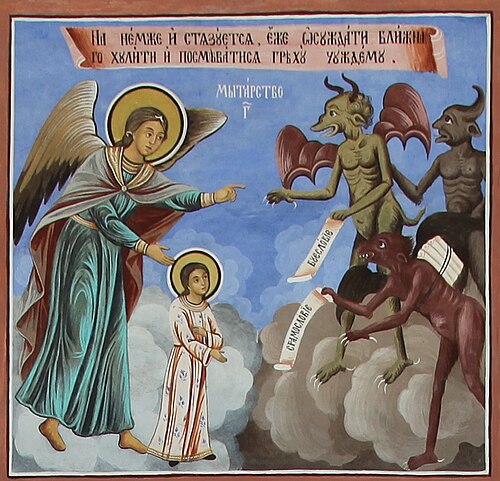
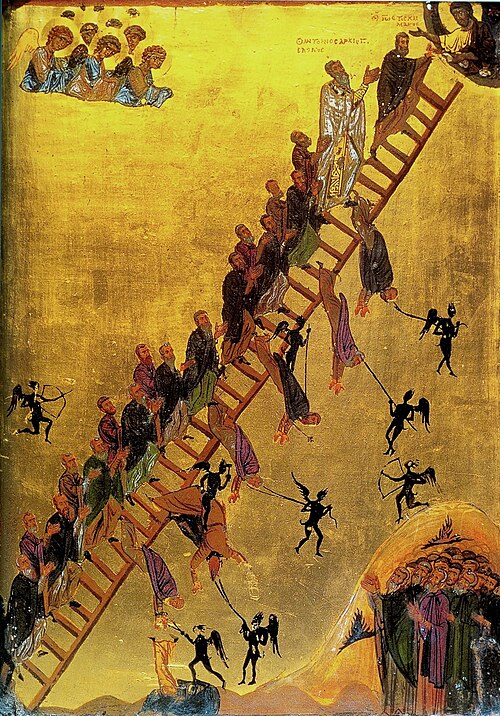
The teaching is also painted on the walls of churches. The toll-houses appear in the iconography of the Last Judgment — most famously in the Russian tradition, where a serpent, the “Serpent of Tribulations,” winds up the centre of the icon with a ring for each toll-house, each ring named for a sin. The motif goes back to at least the fifteenth century, and the same subject appears in the frescoes of the wooden churches of Maramureş in Romania, in the Carpathian and Athonite traditions, and in the frescoes of Rila Monastery in Bulgaria, where each toll-house is painted with the demons examining the soul's sins. A related image of the contested ascent is the most famous of all: the Ladder of Divine Ascent, the twelfth-century icon at St Catherine's Monastery, Sinai, where monks climb toward Christ while black demons pull them off the ladder. The Ladder pictures the ascetic life — thirty steps of virtue — not the soul's passage after death, but it shows the same world: the ascent opposed at every step. That matters, because in Orthodox theology an icon is not decoration. The Seventh Ecumenical Council (Nicaea II, 787) declared that the making of icons belongs to the Church's unwritten tradition, and its acts state that “what a word communicates through hearing is what art shows silently through an image.” A teaching the Church paints on the walls of its churches, and sets before the faithful every year on the Sunday of the Last Judgment, is not one theologian's opinion. It does not follow that the teaching is dogma — icons also depict scenes from the lives of the saints and details no one claims as dogma, and the painted toll-houses vary in number and form from one tradition to another, just as the written accounts do. But the iconography is a third strand, alongside the Fathers and the hymns, and it is the strand a visitor to an Orthodox church can see with their own eyes.
But the teaching has always had its critics inside Orthodoxy, and the dispute has at times been bitter. Fr. Michael Azkoul called Rose's presentation neo-Gnosticism. Archbishop Lazar Puhalo condemned the teaching as heresy of gnostic or pagan origin. The theologian David Bentley Hart considers it a heresy, and Dr. Paul Ladouceur argues that the Life of St. Basil is a forgery — and that it is “misleading and erroneous to present toll-house theology as ‘the teaching of the Orthodox Church’ when in reality it is only part of Orthodox tradition concerning the afterlife.” The controversy grew so sharp that in December 1980 the Synod of Bishops of the Russian Orthodox Church Outside Russia intervened, demanding that the controversy cease “on both sides” and forbidding Puhalo to lecture in the parishes until he signs a pledge satisfactory to the Synod — while its own review noted that a number of teachings, including the particular judgment, are “long accepted in Orthodox Dogmatic Theology,” and called the toll-stations “ancient traditions.” The same review added: “Actually, no one can dogmatically establish the existence of the toll-houses precisely in accordance with the form described in the dream (of Gregory recounted in the life) of Basil the New.”
Rose himself, it should be said, warned against reading the picture literally. The houses, booths, scales and payments are imagery, he wrote, and the numbers and stages are a general rule rather than a law: saints, unattached to earthly places, often begin their ascent immediately, and many recorded cases simply do not follow the pattern. Fr. Thomas Hopko put the teaching in its most general form: after death the demons attempt to convict the soul of unrepented sin and insincerity, while the angels and the prayers of the living help the soul to stand in true repentance. The pastoral purpose of the teaching, as the funeral hymns show, is to prompt repentance and prayer — not dread. Whether it succeeds in that purpose is a fair question, and it is the one the next section takes up.
3. What Scripture says
There is common ground first, and it matters. Scripture agrees that angels escort the departing soul: Lazarus was “carried by the angels to Abraham's side” (Luke 16:22). It agrees that judgment follows death: “it is appointed for man to die once, and after that comes judgment” (Hebrews 9:27). And it agrees that there is an accuser: Revelation calls Satan “the accuser of our brothers” (Revelation 12:10). The disagreement is not about whether the soul is judged, but about who judges, on what basis, and whether the believer can know the outcome today.
The first difference is the thief on the cross. “Truly, I say to you, today you will be with me in paradise” (Luke 23:43). No stations, no delay, no testing, no fortieth day — today, and with Christ himself. The same immediacy runs through the apostles' own expectation of death. Paul's desire was “to depart and be with Christ, for that is far better” (Philippians 1:23), and he writes that to be “absent from the body” is to be “at home with the Lord” (2 Corinthians 5:8). A soul that must pass twenty examinations, at any of which it can be seized, is not the soul Paul describes — and Paul, who calls himself the worst of sinners, expects to be with Christ, not to be weighed.
The second difference is who answers the charge. In the toll-houses the angels answer for the soul, and its good deeds and the prayers of the living are weighed against the demons' record. Scripture gives the believer a different advocate: “we have an advocate with the Father, Jesus Christ the righteous. He is the propitiation for our sins” (1 John 2:1–2). The charge is not answered by a balance of deeds but by a person — and Paul's question stands over the whole scene: “Who shall bring any charge against God's elect? It is God who justifies. Who is to condemn? Christ Jesus is the one who died — more than that, who was raised — who is at the right hand of God, who indeed is interceding for us” (Romans 8:33–34). The toll-houses hand the prosecution to the demons; Romans hands the verdict to God, who has already justified.
The third difference is the record itself. The demons in Theodora's account keep papers, and only repented sins are erased. Colossians says the whole record is gone: God forgave us all our trespasses, “canceling the record of debt that stood against us with its legal demands,” and nailed it to the Cross — and in the same act “disarmed the rulers and authorities and put them to open shame” (Colossians 2:13–15). The accuser was not given a customs post at each station; he was thrown down (Revelation 12:10), and through death Christ “destroyed the one who has the power of death, that is, the devil, and delivered all those who through fear of death were subject to lifelong slavery” (Hebrews 2:14–15). A teaching that restores the accuser's power after death, and makes the believer's fate depend on the state of the record at the last moment, gives back with one hand what the Cross took away with the other.
The fourth difference is assurance. Jesus says: “whoever hears my word and believes him who sent me has eternal life. He does not come into judgment, but has passed from death to life” (John 5:24). The believer has already passed from death to life. The toll-houses postpone that certainty to the fortieth day and make it depend on the prayers of others — Theodora herself says she would not have made it without her spiritual father's prayers. Scripture never asks the dying believer to wait and see, or to hope that others will pray enough. It gives him Christ's own word, today.
The fifth difference is the payment. The toll-houses make the soul pay its way past the demons — its good deeds and the prayers of the living are the currency, and if they run short, the demons seize it. Scripture says the price has already been paid, in full, and it was never owed to demons: “you were bought with a price” (1 Corinthians 6:20), and the price was Christ's own life, given “as a ransom for many” (Mark 10:45). The devil is not a creditor with a claim on the believer — “the ruler of this world is coming,” Jesus said. “He has no claim on me” (John 14:30) — and what he has no claim on in Christ, he has no claim on in those who are Christ's. Theodora needed another's gold to get through; the believer carries something better — “the free gift of God is eternal life in Christ Jesus our Lord” (Romans 6:23) — and on the Cross the payment was finished: “It is finished” (John 19:30). A teaching that sends the dying believer to pay demons what Christ has already paid is not the gospel; it is the gospel undone.
Why it matters — three questions
None of this is abstract. For someone considering Orthodoxy, the toll-houses are the question of what they would actually face at the hour of death — and what they would be taught to expect. Three questions are worth carrying into that decision.
Who will speak for you? Angels weighing your deeds against a demonic record — or Christ your Advocate, whose blood answers every charge? The two pictures do not describe the same courtroom.
What carries you through? The balance of your life, plus the prayers of the living, with the outcome uncertain until the fortieth day — or the finished work of the Cross, which cancelled the record entirely? One leaves the dying believer hoping; the other leaves him knowing.
Can you know today? The thief heard “today you will be with me in paradise.” If the answer to that question must wait for twenty stations and forty days, then assurance is not something the believer can have in this life — and the fear of death, which Hebrews says Christ came to destroy, is back in charge.
That is the conversation this series exists for.
Sources: The teaching as stated here follows the standard Orthodox accounts: the Life of Basil the Younger (d. 944) and Theodora's vision as commonly summarised, including the twenty toll-houses and the prayers of her spiritual father; Archbishop John Maximovitch, “Life After Death” (1965), printed by Hieromonk Seraphim Rose as the final chapter of The Soul After Death (1980); the instruction to St. Macarius of Alexandria on the third, ninth and fortieth days; the Octoechos canon attributed to St. John of Damascus (“the bitter toll-houses”); St. Ignatius Brianchaninov, St. Justin Popović's Dogmatics of the Orthodox Church, and Metropolitan Hierotheos Vlachos among its defenders; Fr. Thomas Hopko's summary of the teaching in its general form. The demand for payment itself is stated by Clement of Alexandria (Stromata 4.18: “those who demand the toll”), the Macarian Homilies (14.15: as toll-collectors detain passers-by and extort them, so the demons seize souls), and Theodora's account (Dumbarton Oaks edition, 2014), where the demons “exact payment” and Basil's gold frees her from her debts. The usage that calls the demons themselves τελώνια is St Macarius's (quoted in Archbishop Christodoulos, Η ζωή μετά θάνατον) and Metropolitan Hierotheos Vlachos's (Η ζωή μετά τον θάνατο). The controversy is documented in the Wikipedia survey “Aerial toll house” (supporters and critics named, including David Bentley Hart, Paul Ladouceur, Archbishop Lazar Puhalo and Fr. Michael Azkoul) and in the December 1980 statement of the Synod of Bishops of the Russian Orthodox Church Outside Russia. The iconography follows Raluca Betea, “The Trial of the Soul” (2011), on the toll-booths in the Last Judgment frescoes of the wooden churches of Maramureş, Romania; Boris K. Knorre's analysis of a seventeenth-century Yaroslavl Last Judgment icon (the “Serpent of Tribulations”); and the iconography chapter of The Departure of the Soul (St. Anthony's Greek Orthodox Monastery, 2017), whose galleries cover the Mount Athos, Carpathian, Russian and Romanian traditions; the Nicaea II quotation is from Act 6 of the Seventh Ecumenical Council (787). Honest limits: this piece is built from published summaries and secondary sources, not from a fresh reading of Rose's book in full or of the Life of Basil the Younger in the original; the twenty toll-houses are listed as commonly given, and the number is not dogmatic; the teaching's status is disputed within Orthodoxy, and the piece states the dispute rather than settling it; Scripture references are quoted from the English Standard Version.
Related reading: What Orthodoxy teaches about salvation — on salvation; Orthodox soteriology, from an Evangelical perspective — four talks by Rev. Giotis Kantartzis on salvation in Orthodox theology, with video, timestamped main points and English subtitles; Ecclesiology — nine talks by Sotiris Boukis on what the Church is; In dialogue with Orthodoxy — the series this piece belongs to, with the topics to come: icons, relics, the Theotokos, the sacraments, prayer to the saints, the anathemas.
Researched and drafted with the help of Muse, an AI assistant. Every claim is checked against its sources, and every article is approved by Aris Angelakopoulos before publication.