What Orthodoxy teaches about the Theotokos
Mary is the most honoured woman in the Christian world. In every Orthodox church her icon stands beside her Son’s, at the left of the Royal Doors; every Liturgy commemorates her as “our most holy, pure, blessed, and glorious Lady”; every August the faithful keep a two-week fast for her Dormition and sing the Paraklesis evening after evening. She is, in the Church’s own words, “more honourable than the Cherubim, and more glorious beyond compare than the Seraphim.”
Scripture honours her too — and this piece honours her with it. The question is not whether Mary is honoured, but what the honour has become. The title the Church gave her began as a guard on Christ: the child she bore was God, and the title said so. That first idea had merit. But it was lost very fast. By the sixth century the feasts were multiplying — the Annunciation, the Nativity of the Theotokos, the fifteenth of August turned from a feast of her maternity into a feast of her Dormition. In 649 the Lateran Synod stated the threefold virginity in full. By the eighth century John of Damascus was preaching the Dormition, and the Paraklesis was asking her to save. The Church teaches that she was ever-virgin, that she never committed a personal sin, that her body was taken up to heaven, and that she hears the prayers of the faithful and intercedes for them. This piece states each teaching fairly, from the Church’s own sources — and then asks what each teaching rests on. And it looks at what the people actually sing and do, because on the Church’s own account what the people have received and kept is binding: the worship is not a deviation from the teaching. It is the teaching.
1. The title — and why there is no quarrel with it
The title Theotokos means “God-bearer”, or “Mother of God”. It was already in use before the council that vindicated it. Alexander of Alexandria, writing against Arius about 320, calls her “Mary the Mother of God” — incidentally, in an argument about the reality of Christ’s body, without explaining the word, as if his readers already knew it. Athanasius uses it the same way: “He took flesh of a Virgin, Mary Bearer of God, and was made man.” Gregory Nazianzen, writing to Cledonius in 382 or 383, made it a test of the faith itself: “If anyone does not believe that Holy Mary is the Mother of God, he is severed from the Godhead.”
The council came in 431. Nestorius, the bishop of Constantinople, had defended a presbyter who preached that no one should call Mary Theotokos — “for Mary was but a woman; and it is impossible that God should be born of a woman” — and proposed Christotokos, “Christ-bearer”, instead. Cyril of Alexandria answered that refusing the title divided Christ into two subjects: if Mary bore only the man, then the man she bore was not God. The council at Ephesus approved Cyril’s second letter to Nestorius as agreeing with the faith of Nicaea, and deposed Nestorius. It issued no new creed and no formal definition of the title itself — the sharpest form of the anathema (“If anyone will not confess that the Emmanuel is very God, and that therefore the Holy Virgin is the Mother of God, inasmuch as in the flesh she bore the Word of God made flesh: let him be anathema”) is Cyril’s own, read at the council, and whether the council adopted his anathemas is still debated among historians. Chalcedon, twenty years later, wrote the title into its Definition: Christ was “born of the Virgin Mary, the Mother of God according to his manhood.”
What the title means is the point. Cyril himself explained it in the letter Ephesus approved: the Fathers called Mary the Mother of God “not as if the nature of the Word or his divinity had its beginning from the Holy Virgin, but because of her was born that holy body with a rational soul, to which the Word being personally united is said to be born according to the flesh.” John of Damascus, three centuries later, said the name “embraces the whole mystery of the dispensation. For if she who bore Him is the Mother of God, assuredly He Who was born of her is God and likewise also man.”
The title, that is, is about Christ. It guards the person of Christ: the child Mary bore was God. An evangelical has no quarrel with it. The quarrel is not with what Ephesus did. It is with what grew around the title in the centuries after Ephesus — and how fast it grew. Ephesus guarded a title. What no council ever did was define what the title would come to carry. The sinlessness was never defined. The Dormition was never defined. The threefold formula came from a Western synod in 649, not from an ecumenical council. The honours grew without definition — and that is the story of this piece.
2. The Ever-Virgin
The Church teaches that Mary was a virgin before, during, and after the birth of Christ — aeiparthenos, “ever-virgin”. The title is confessed at Constantinople II (553), whose second anathema speaks of “the holy and glorious Mary, Mother of God and always a virgin”. But the council confesses only the title: the explicit threefold formula — virgin before the birth, in the birth itself, and after it — is stated only at the Lateran Synod of 649, a Western synod under Pope Martin I: Mary “without loss of integrity brought Him forth, and after His birth preserved her virginity inviolate.” And the Greek acts of 553 are lost; what survives is a Latin version.
The narrative behind the middle term — virginity in partu, in the act of giving birth — comes from the Protoevangelium of James, a second-century apocryphon. In its nineteenth and twentieth chapters, the midwife tells Salome that “a virgin has brought forth — a thing which her nature admits not of,” and Salome answers: “As the Lord my God lives, unless I thrust in my finger, and search the parts, I will not believe that a virgin has brought forth.” She does, and her hand withers. The book is the earliest surviving text to assert Mary’s perpetual virginity in the full sense, and the source of the traditions of her parents Joachim and Anna, her presentation in the Temple, and Joseph as an elderly widower. The Church receives its traditions — two of its twelve Great Feasts, the Nativity of the Theotokos and her Entry into the Temple, come from this book — while not treating the book as Scripture.
So the doctrine stands on a book the Church itself does not count as Scripture, and its fullest form was stated by a Western synod two centuries after the council that confessed the title. The “brethren” of Jesus named in the Gospels are explained two ways in the tradition: the Protoevangelium makes them Joseph’s children by a former marriage; Jerome, answering Helvidius in 383, made them cousins. The two explanations contradict each other, and neither is in the Gospels — and the Church has never chosen between them.
There is a further question, and it is about motherhood itself. The doctrine does not deny that Mary was a mother — she is honoured precisely as Mother. But it ranks virginity above motherhood, and the ranking is built into the argument. The consecration case — the vessel that bore God cannot return to ordinary use — only works if ordinary use is lesser than consecrated use. If motherhood were as holy as virginity, there would be no reason the womb could not bear more children. So the holiest woman in history had exactly one child, by miracle, and never knew a man — and the model of female holiness becomes a woman who never had ordinary married life. Scripture points the other way. Fruitfulness is the first blessing — “Be fruitful and multiply” (Genesis 1:28), given before the Fall, not as a concession to it. “Children are a heritage from the LORD, the fruit of the womb a reward” (Psalm 127:3). Barrenness is a sorrow, and its removal a blessing — Elizabeth calls her pregnancy God taking away her “reproach among people” (Luke 1:25). And the sharpest text is Hebrews 13:4: “Let marriage be held in honor among all, and let the marriage bed be undefiled.” If the marriage bed is undefiled, then Mary’s marital relations with Joseph would not have defiled her womb — and the consecration argument falls. The Orthodox reply is that the ever-virginity is about the uniqueness of this birth, not about motherhood in general. The reply is fair as far as it goes. But it concedes the point it needs to deny: if the womb’s holiness required no further children, then ordinary childbearing is treated as a diminishment — and Hebrews 13:4 says it is not. The reply restates the tension; it does not dissolve it.
3. The sinlessness
The teaching is that Mary never committed a personal sin. Kallistos Ware: “all Orthodox are agreed in believing that Our Lady was free from actual sin.” Vladimir Lossky: “the Holy Virgin was born under the law of original sin, sharing with all the same common responsibility for the Fall. But sin never could become actual in her person; the sinful heritage of the Fall had no mastery over her right will.” The liturgy calls her achrantos — spotless, undefiled — and panamomos — all-blameless. Every Divine Liturgy commemorates “our most holy, pure, blessed, and glorious Lady, the Theotokos and ever-virgin Mary.”
This is not Rome’s Immaculate Conception, and the difference matters. Rome defined in 1854 that Mary was preserved from original sin from the first moment of her conception. Orthodoxy rejects that: the 1895 Encyclical of the Eastern Patriarchs calls it an innovation “unknown to the ancient Church”. On the Eastern understanding, what Adam’s children inherit is mortality and corruption, not guilt — and Mary shared in it. John Meyendorff: “the inheritance from Adam is mortality, not guilt, and there was never any doubt among Byzantine theologians that Mary was indeed a mortal being.” She was born in the normal way, and she died. Her cleansing is located at the Annunciation, when the Spirit came upon her, not at her conception. Ware notes, honestly, that the Church “has never in fact made any formal and definitive pronouncement on the matter” — the rejection is the great majority’s position since 1854, not a dogmatic definition, and an Orthodox who believed the Latin dogma “could not be termed a heretic for so doing.”
But the encyclical’s test cuts both ways. A sinlessness with no text behind it, confessed by no council, and contradicted by the Church’s own greatest preacher, is not a teaching the ancient Church knew either. Rome defined what it could not prove; Orthodoxy holds, without defining, what it cannot prove. The difference is one of degree, not of kind.
The obvious question is the Magnificat. Mary calls God “my Saviour”: “my spirit rejoices in God my Saviour, for he has looked on the humble estate of his servant” (Luke 1:47–48). If she never sinned, what did she need saving from? The Orthodox answer is stated in Orthodox sources, and it deserves to be heard. Thomas Hopko: “Mary truly needed to be saved by Christ as all human persons are saved from the trials, sufferings and death of this world.” Ignatius Brianchaninov, more bluntly: “If God is her Saviour, then she was conceived and born in sin according to the common law of fallen humanity.” She needed a Saviour from death and corruption, from the ancestral inheritance — not from personal sins, because she had none.
That is a coherent answer. The question is what it rests on. The sinlessness is asserted without a single text that says it. The Gospels show her, more than once, not understanding. At twelve years old, Jesus asks, “Did you not know that I must be in my Father’s house?” — “and they did not understand the saying that he spoke to them” (Luke 2:49–50). At Cana: “Woman, what does this have to do with me? My hour has not yet come” (John 2:4). When she and his brothers stood outside asking to speak to him, he answered: “Who is my mother, and who are my brothers?” (Matthew 12:46–48). And the Church’s own greatest preacher disagreed with the later teaching: Meyendorff records that Chrysostom “found it possible to ascribe to Mary not only ‘original sin,’ but also ‘agitation,’ ‘trouble,’ and, even, ‘love of honor.’” The unanimity Ware describes is real today. It was not the unanimity of the Fathers.
And then there is Paul: “for all have sinned and fall short of the glory of God” (Romans 3:23). The Orthodox answer to Luke 1:47 is coherent on its own terms — she was saved from death and corruption, not from sins she never committed. But coherence is not evidence. The sinlessness rests on the hymns — achrantos, panamomos — and on a consensus that formed centuries after the apostles, against the silence of Scripture and the disagreement of the Church’s own greatest preacher. The woman who called God her Saviour is the only witness to her own soul in the New Testament. And she called Him her Saviour.
4. The Dormition
The tradition is this: Mary died, the apostles were gathered to Jerusalem by clouds, she was buried at Gethsemane, Thomas arrived on the third day, the tomb was opened and found empty except for her burial wrappings, and her body had been translated to heaven. The Synaxarion tells it in full; the shorter Menaion reading for 15 August omits Thomas. The feast of the Dormition, 15 August, is one of the twelve Great Feasts, and the hymns state it as fact. The kontakion: “Neither the tomb, nor death had power over the Theotokos... For as the Mother of Life, she was translated into life by Him who dwelt in her ever-virginal womb.” The apolytikion: in her Dormition she did not forsake the world, and she “passed into life”.
The earliest narratives of Mary’s end, as Stephen Shoemaker’s work shows, are apocryphal — the Book of Mary’s Repose, probably third century, and the Six Books, mid-fourth century. John of Damascus’s homilies carry the tradition into the Church’s teaching, and the Thomas passage in his second homily is an early insertion from the Euthymiac History — present in all the manuscripts, but not Damascene’s own composition. The passage itself admits what the tradition admits: “There is nothing in the holy, inspired Scripture about the death of Mary, the holy Mother of God; but we know from ancient and wholly reliable tradition...”
The Church’s own Synaxarion says what kind of teaching this is. Nikodemos the Hagiorite calls the Metastasis “a secret doctrine passed on by the Holy Fathers orally and not through public proclamation.” A teaching passed on orally, in secret, cannot be checked against anything written — and that is the point. What the Church sings as certain about Mary’s end, it received by word of mouth; it will not define it as dogma, and it will not let anyone deny it.
Hopko, in the OCA’s Orthodox Faith: “there are no biblical or historical sources for this feast.” Epiphanius of Salamis, the earliest Father to ask what happened to Mary at the end, said that no one knows her end. And the Church has never dogmatically defined the Dormition. Georges Florovsky: “the dogmatic reticence of the Church in Mariological doctrine. The Church speaks of her rather in the language of devotional poetry, in the language of antinomical metaphors and images.”
The fairness point must be stated plainly: “not formally defined” does not mean an Orthodox Christian may deny the Dormition. As OrthoChristian.com puts it, it is “no less an unwavering teaching of the Orthodox Church.” The Church sings it as fact, celebrates it as a Great Feast, and holds it as unwavering teaching — without ever having defined it as dogma.
But that is the point. What the Church sings as certain, it will not define as dogma. What it will not define, it will not let anyone deny. And what it sings comes from apocryphal narratives of the third and fourth centuries, about an event its own theologian says has no biblical or historical source, and about which its earliest Father said no one knows. A teaching can be sung, celebrated, and held unwavering — and still rest on nothing the apostles wrote.
The honours grew over centuries. The first Marian feast in Constantinople is attested about 430, when Proclus preached a homily for it in Nestorius’s presence. The 15 August feast appears in the Armenian Lectionary of 412–439 — but as a feast of the maternity, not yet of the Dormition. Tradition credits the emperor Maurice (582–602) with extending it empire-wide; the Annunciation and the Nativity of the Theotokos are sixth-century; the Entry into the Temple, from the Protoevangelium‘s seventh chapter, sixth to eighth. Justinian elevated the Hypapante empire-wide in 542, in thanksgiving for the end of the plague. Three centuries of growth, from apocrypha and imperial decree — while the New Testament, after Acts 1:14, never mentions Mary again.
5. The intercession
At every Divine Liturgy, after the consecration, the choir sings: “More honourable than the Cherubim, and more glorious beyond compare than the Seraphim, who without corruption gavest birth to God the Word, true Theotokos, we magnify thee.” In the Paraklesis, the service of supplication sung through the Dormition fast, the refrain before every troparion is: “Most Holy Theotokos, save us.” The Akathist calls her the one through whom “creation is made new” and asks her, as the “Victorious Leader of triumphant hosts” who possesses “invincible might”, to “set us free from every calamity”. Its opening hymn says it outright: “As thou dost possess invincible might set us free from every calamity.” Invincible might, and the power to set free from every calamity, is asked of her — not of her Son.
The Orthodox defence is fair and must be heard. John Breck: “Mary in no way replaces her Son in the work of salvation, nor does she serve in the technical sense as ‘mediatrix’ or mediator between God and us.” The OCA’s answer to the question: “There is only one intercessor before God the Father – Jesus. Mary and the Saints intercede for us before Christ, just as she did at the first miracle in John 2.” Ware: “We honour Mary because she is the Mother of our God. We do not venerate her in isolation, but because of her relation to Christ.” The Church does not regard her as a fourth person of the Trinity, nor assign to her the worship due to God alone. Nicaea II drew the line the same way for the icons: “due salutation and honourable reverence, not indeed that true worship of faith which pertains alone to the divine nature.”
And the Church’s own preachers say it plainly. An OCA homily explains that “as one who saves a man drowning, Mary saves us from dangers, as Joseph did for his brothers in Genesis 45:5.” That is not a theologian’s careful distinction. That is the preaching: Mary saves us from dangers. The defence says “save” means something secondary; the pulpit says she saves.
And the Church itself once drew the line harder. In the fourth century, the Collyridians — women in Arabia who offered cakes to Mary as to a goddess — were condemned by Epiphanius of Salamis: “Mary should be honored, but the Father, the Son and the Holy Spirit should be worshiped; no one should worship Mary.” And: “she was not given us to worship; she worships Him who, though born of her flesh, has come from heaven, from the bosom of his Father.” Epiphanius drew the line at worship. The hymns the people sing have crossed it in everything but the name.
The defence distinguishes intercession from mediation, honour from worship. But the hymns do not make the distinction. “Save us” is the word Scripture reserves for God — and it is the refrain of the Paraklesis, sung by the people, not a theologian’s careful phrase. The theologian explains that “save” means something secondary; the hymn says “save us” and means it. And the intercession itself presupposes what belongs to God alone: millions of the faithful pray to her at once, in every time zone, in every language — to hear them all, she must be everywhere; to answer, she must know every heart. Omnipresence and heart-knowledge are the attributes of God. The Church asks of Mary what only God can do, and explains that it is not asking what it seems to ask.
Scripture gives the work to the risen Christ, not to his mother: “he is able to save to the uttermost those who draw near to God through him, since he always lives to make intercession for them” (Hebrews 7:25). The intercession is his, because he lives. And the advocate with the Father is named: “we have an advocate with the Father, Jesus Christ the righteous” (1 John 2:1). The Orthodox answer is that Mary intercedes before Christ, not before the Father. But John names the advocate with the Father, and it is Jesus — not Mary before Jesus.
Paul’s sentence stands over the whole practice: “there is one God, and there is one mediator between God and men, the man Christ Jesus” (1 Timothy 2:5). The Orthodox answer is that Mary intercedes before Christ, not before the Father — as she did at Cana. But at Cana, she was present in the room, and she spoke to her Son face to face. The intercession the Church now asks of her is of one who hears every prayer of every believer at once. That is not the intercession of Cana. It is the intercession of one who is everywhere — and only God is everywhere.
6. What the people believe
On the first of August the fast begins. For two weeks, until the feast on the fifteenth, the faithful keep the Dormition fast — and evening after evening they gather to chant the Paraklesis, the service of supplication to the Theotokos. The Archdiocese describes the order of the fast plainly: the Small Paraklesis is "conducted in alternation with the Great Paraklesis during the Dormition fast (August 1-14)". The Small Paraklesis is by Theosteriktos the Monk, who died in 807; the Great Paraklesis is by the Emperor Theodore II Laskaris, who reigned from 1254 to 1258 and composed it in illness. Before every troparion in both canons the refrain is the same: "Most Holy Theotokos, save us." The year has other seasons of the same singing. On the Fridays of Lent the faithful sing the Akathist, twenty-four stanzas telling them that through her "creation is made new" and asking her, who possesses "invincible might", to "set us free from every calamity". And at every Liturgy, all year round, they commemorate her as "our most holy, pure, blessed, and glorious Lady", and after the consecration they sing that she is "more honourable than the Cherubim, and more glorious beyond compare than the Seraphim".
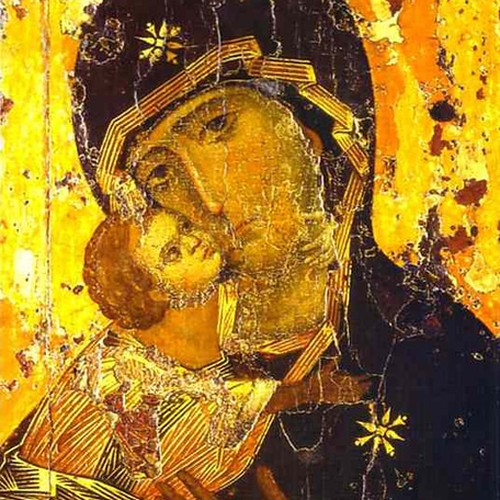
These services are sometimes described as mere devotion — the piety of simple people, not the teaching of the Church. But they are not customs the people invented. They stand in the Church's own books. The Horologion prints the Small Paraklesis under Theosteriktos's name. The Akathist "holds the place of honour" in the appointed service of the fifth Saturday of Lent. The feast the August fast prepares for stands on the calendar among the twelve Great Feasts. The Archdiocese publishes the texts and teaches the faithful to chant them. A Church cannot print "save us" in its own service books, appoint the services on its own calendar, and then call the singing unofficial when it is examined.
So the refrain is not a folk cry. It is the Church's own prayer, printed and appointed: "Most Holy Theotokos, save us." And Scripture answers it with one sentence: "there is one God, and there is one mediator between God and men, the man Christ Jesus" (1 Timothy 2:5). The defence says Mary intercedes before Christ, as she did at Cana. But the refrain does not ask her to pray. It asks her to save. "Save us" is sung to her in the Church's own services, evening after evening, every August — and Paul gives the saving to the one mediator. The title that guarded who Christ is has become a refrain that asks his mother to do what he alone is named to do.
7. What Scripture says
Scripture honours Mary, and this piece honours her with it. The angel’s greeting: “Greetings, O favored one, the Lord is with you!” (Luke 1:28). Elizabeth: “Blessed are you among women, and blessed is the fruit of your womb!” (Luke 1:42). Mary herself: “from now on all generations will call me blessed” (Luke 1:48). She is blessed among women — the highest honour Scripture gives any woman, and the Church is right to give it.
But the honour Scripture gives her is the honour of a woman who was graced, not of a woman set apart from the rest of humanity. The word the angel uses — kecharitomene, “favoured one” — is the same Greek verb Paul uses in Ephesians 1:6 of all believers: God “has blessed us in the Beloved.” The grace that rested on Mary is the grace that rests on every believer. And Mary herself names what she is: “Behold, I am the servant of the Lord” (Luke 1:38). A servant — not a queen, not a mediatrix, not the one to whom “save us” is said.
And when the honour was offered to her in person, Jesus redirected it. A woman in the crowd cried out: “Blessed is the womb that bore you, and the breasts at which you nursed!” He answered: “Blessed rather are those who hear the word of God and keep it!” (Luke 11:27–28). When his mother and brothers stood outside asking to speak to him, he stretched out his hand toward his disciples: “Here are my mother and my brothers! For whoever does the will of my Father in heaven is my brother and sister and mother” (Matthew 12:49–50).
After Pentecost, the New Testament falls silent about her. Her last appearance is in the upper room: “All these with one accord were devoting themselves to prayer, together with the women and Mary the mother of Jesus, and his brothers” (Acts 1:14). She is there, praying with the rest — not prayed to, not invoked, not taught about. The apostles never name a feast for her, never ask her intercession, never call her sinless, never say she was assumed. The woman of Revelation 12, “clothed with the sun”, has been read as Mary by some Fathers and as the Church by others — Hippolytus, the earliest witness, read her as the Church — and the Fathers never agreed on it.
The first idea had merit: the child Mary bore was God, and the title said so. It was lost very fast — and what was lost was not a detail. A title that guarded Christ became a Mariology that takes from Christ: a Saviour she does not need, an assumption Scripture never records, an intercession that asks of her what only God can do. The Church honours her beyond what Scripture honours her, and the honour has become something Scripture never gives to any creature: a sinlessness without a text, an assumption without a source, an intercession that asks of her what only God can do.
Mary is blessed among women. Scripture says so, and the Church is right to say it. But Scripture never calls her sinless, never says she was assumed, never asks her to save anyone — and the Church that does all three has built its highest honours on apocrypha, on hymns, and on silence. The woman who called herself the servant of the Lord would not recognise the woman who needs no Saviour. Honour her as Scripture honours her: blessed among women — and saved by the Son she bore.
Sources. Scripture quotations follow the English Standard Version. The title: Alexander of Alexandria, encyclical against Arius (in Theodoret, Church History I.3–4); Athanasius, Orations against the Arians III.29; Gregory Nazianzen, Letter 101; Cyril of Alexandria, second letter to Nestorius and Anathema 1, and the acts of Ephesus (431) — all in the Nicene and Post-Nicene Fathers; John of Damascus, Exact Exposition of the Orthodox Faith III.12. The Ever-Virgin: Constantinople II (553), Anathemas 2 and 6 (the Greek acts are lost; the text survives in Latin); the Lateran Synod of 649, Canon 3 (Denzinger 503); the Protoevangelium of James, chs. 19–20 (Walker translation, Ante-Nicene Fathers 8). The sinlessness: Kallistos Ware, The Orthodox Church; Vladimir Lossky, "Panagia", in In the Image and Likeness of God; John Meyendorff, Byzantine Theology; the 1895 Encyclical of the Eastern Patriarchs; Thomas Hopko, The Orthodox Faith, vol. II; Ignatius Brianchaninov, Ascetic Sermons, ch. 63. The Dormition: the Synaxarion of Nikodemos the Hagiorite; John of Damascus, Homilies on the Dormition (the Thomas passage in Homily II §18 is an early insertion from the Euthymiac History, present in all manuscripts but not Damascene's own composition; English text as given at saintsilouan.org); Stephen J. Shoemaker, Ancient Traditions of the Virgin Mary's Dormition and Assumption; Georges Florovsky, "The Ever-Virgin Mother of God", in Collected Works III; Epiphanius, Panarion 78.11, as quoted in Brian E. Daley, On the Dormition of Mary, introduction; the 15 August hymns from the liturgical books (GOARCH). The intercession: the Akathist Hymn and the Paraklesis canons (GOARCH liturgical texts); John Breck, "Most Holy Theotokos, Save Us!", OCA, 2003; the OCA Diocese of New York and New Jersey, "Seven Questions, Seven Answers"; Epiphanius, Panarion 79 (Frank Williams translation); Nicaea II (787), horos. What the people believe: the Paraklesis canons — the Small Paraklesis by Theosteriktos the Monk (d. 807), the Great Paraklesis by Emperor Theodore II Laskaris (reigned 1254–1258) — and the Akathist Hymn (GOARCH liturgical texts); the Greek Orthodox Archdiocese of America's Dormition page (the Small Paraklesis "conducted in alternation with the Great Paraklesis during the Dormition fast (August 1-14)"); the Archdiocese's chapel reading for the Akathist Hymn, 5th Saturday of Lent; the Horologion's attribution of the Small Paraklesis to Theosteriktos the Monk. The feast chronology: "Marian Feasts", New Catholic Encyclopedia; Egeria, Diary of a Pilgrimage, ch. 26. Revelation 12: the patristic survey of Stergios N. Sakkos (Thessaloniki, 1991). Stylianos Charalampakis, Τα Ανάποδα της Θρησκείας, Letters 19 and 23, was used as one resource among others; the book's errors found in research were not used. Full research notes: ~/workspace/research_notes/theotokos-20261124/report.md.
Related reading: What Orthodoxy teaches about Mary’s children · What Orthodoxy teaches about Scripture and Tradition · What Orthodoxy teaches about icons · What Orthodoxy teaches about the canon of Scripture
Researched and drafted with the help of Muse, an AI assistant. Every claim is checked against its sources, and every article is approved by Aris Angelakopoulos before publication.