What Orthodoxy teaches about the Church
The Orthodox Church makes a claim about herself that no other church makes in the same form. She does not say she is a church, or the oldest church, or the church closest to the apostles. She says she is the one, holy, catholic and apostolic Church confessed in the Creed — one, because God is one; indivisible, because her unity rests on God and not on men; the fullness of truth, lacking nothing. Outside her canonical boundary, on this claim, there is no full communion with God.
The record is different. In 2016 the council that was to display the one Church’s unity met with four of her fourteen churches absent, and her parts disagreed in the same month over whether its documents bind anyone. Since 2018 the two oldest patriarchates that claim to be the one Church have not been in communion with each other. The same convert’s baptism is recognised as baptism by one Orthodox jurisdiction and repeated by another. In 1666 the Church anathematised her own previous rite; in 1971 she declared that rite equally saving; the schism that followed has never healed. The claim has been defined so that none of this can touch it. That is the verdict. What follows is the evidence: the claim as the Church herself states it, what Scripture says, the cases tested against the claim, what her icons show, and what her people actually live.
1. What she says she is
The claim, at its strongest, is not modest, and it should be heard in the Church’s own words. Thomas Hopko, whose Orthodox Faith is the standard English exposition of the teaching, states it plainly: “The Church is one because God is one... There can only be one Church and not many. And this one Church, because its unity depends on God, Christ, and the Spirit, may never be broken. Thus, according to Orthodox doctrine, the Church is indivisible; men may be in it or out of it, but they may not divide it.” And again: “Without the Church as a divine, mystical, sacramental, and spiritual reality, in the midst of the fallen and sinful world there can be no full and perfect communion with God.” The Holy Synod of the Orthodox Church in America has a section headed “The Orthodox Church is the True Church”: “The Church of Christ is ‘the Church of the living God, the pillar and ground of the truth’ (I Timothy 3:15)... The Church lives by Jesus Christ as His true body and bride. The only head of the Church is Christ.” The Holy and Great Council of 2016, in the text prepared for it at Chambésy, says the Orthodox Church “being the One, Holy Catholic and Apostolic Church, in her profound ecclesiastical consciousness firmly believes that she occupies a central place in matters relating to the promotion of Christian unity within the contemporary world,” and that “the preservation of the true Orthodox faith is only possible thanks to the conciliar structure which since ancient times has been for the Church the strong and final criterion in matters of faith.”
The teaching has a theological shape, and it is not a crude institutionalism. Sergius Bulgakov, the Russian theologian, writes: “Orthodoxy is the Church of Christ on earth. The Church of Christ is not an institution; it is a new life with Christ and in Christ, guided by the Holy Spirit.” Metropolitan Anthony Bloom puts it the same way: “Above all the Church is defined in the words of Saint Paul: the Church is the Body of Christ... the Church is an extension of the Incarnation. Each one of us is a presence of Christ.” The local church, on this teaching, is not a part of the Church. Hopko again: “every local community of Orthodox Christians with a priest must be, and theologically understood actually is, the one Church of Christ. Theologically speaking, there are not many Orthodox Churches; there is only one.” Even the word “catholic” is defined carefully: it means “full, complete, whole, with nothing lacking” — a quality, not a quantity. When Orthodoxy says “catholic” she does not mean “worldwide”; she means “lacking nothing.” The question this piece asks is not about the word. It is about the claim to lack nothing.
Three patristic anchors hold the teaching up, and each should be stated fairly, with its context. Ignatius of Antioch, writing about A.D. 107, a generation after the apostles, tells the Smyrnaeans: “Let no man do aught of things pertaining to the Church apart from the bishop. Let that be held a valid eucharist which is under the bishop or one to whom he shall have committed it. Wheresoever the bishop shall appear, there let the people be; even as where Jesus may be, there is the universal Church. It is not lawful apart from the bishop either to baptize or to hold a love-feast.” This is the first surviving use of “the catholic Church,” and the Orthodox reading of it is not invented; it is there in the text. But the context is also there: Ignatius writes to one city’s church about its own bishop, in a letter against a division that denied Christ’s real flesh. He does not describe a worldwide institution with a hierarchy of patriarchs, and the distance between Ignatius’s Smyrna and the modern patriarchate is part of the argument. Irenaeus of Lyons, writing against the Gnostics who claimed secret knowledge above the apostolic preaching, says: “For where the Church is, there is the Spirit of God; and where the Spirit of God is, there is the Church, and every kind of grace; but the Spirit is truth.” Irenaeus’s “Church” is the community that holds the public, apostolic faith. The sentence cuts both ways, and Irenaeus’s own next words say how: the Spirit’s presence is known by the truth He teaches. Cyprian of Carthage, writing in 251 against the rival church of Novatian in Rome, says: “He can no longer have God for his Father, who has not the Church for his mother. If any one could escape who was outside the ark of Noah, then he also may escape who shall be outside of the Church... He who does not hold this unity does not hold God’s law, does not hold the faith of the Father and the Son, does not hold life and salvation.” And in a letter on heretical baptism: “There is no salvation outside the Church.” Cyprian was not writing about evangelicals; he was writing about schismatics and heretics of his own day. But the Orthodox reception of Cyprian has never confined the sentence to its occasion: it is quoted as a standing statement of the Church’s boundaries, and it does its practical work where converts are received, as §3 shows. A 2025 article in Theologia, the journal of the Church of Greece, affirms Cyprian — “Saint Cyprian’s position is absolutely correct and necessary” — and in the same breath withdraws it: “This proposition does not dogmatically exclude the salvation of those who are outside the Orthodox Church’s canonical boundaries.” A sentence affirmed and denied in the same paragraph is not a teaching. It is a shield.
The tradition also has a warmer image, and it is genuinely in the sources. John Chrysostom, preaching on repentance, says: “For here is a hospital, not a courtroom; not the demand for punishment of sins, but there is the forgiveness of sins.” Canon 102 of the Council in Trullo (692) tells the priest to “consider the type and the degree of the sin, and the readiness of the sinner for repentance, and to apply medicine suitable for the disease.” The hospital image is real, and it is attractive. The evangelical question is not whether the Church should heal. It is who holds the medicine, and whether the medicine is the gospel preached and believed, or a sacramental system administered by a priesthood.
And then there is the sentence the whole defence turns on. Hopko: “the earthly members and institutions of the Church cannot be identified as such with the Church as holy.” Alexei Khomiakov, the nineteenth-century Russian thinker, wrote that “the Church is not an authority, just as God is not an authority, just as Christ is not an authority; for an authority is for us something external. Not an authority, I say, but truth, and at the same time the life of a Christian, his inner life.” Berdyaev, summarising Khomiakov, puts it plainly: “the essence of the Church is inexpressible; like all living organisms, she cannot be encompassed by any formula, is not subject to any formal definitions... No formal characteristics define the essence of the Church.” This is presented as part of the teaching, and it is part of it. But notice what it does. When the institution acts well, it is the Church; when it fails, it was only men. The claim is asserted of the institution when it is honoured and withdrawn when it is judged. A Church that cannot be defined cannot be tested — and a claim that cannot be tested is not being believed. It is being protected. That is the claim, at its strongest, from the Church’s own sources. Now the test.
2. What Scripture says
The New Testament speaks of the Church often, and it does not speak the way the claim speaks. Begin with the promise itself: “And I tell you, you are Peter, and on this rock I will build my church, and the gates of hell shall not prevail against it” (Matthew 16:18). The promise is Christ’s, about his church — the people he builds on the confession, made in the verses just before, that he is the Christ. It is not a certificate issued to any institution that later claims the name. The gates of hell have not prevailed against Christ’s church in any century; they have prevailed, repeatedly, against the peace and unity of the institutions that claim to be it. And the head of the body is named in the same breath as the body: “And he is the head of the body, the church. He is the beginning, the firstborn from the dead, that in everything he might be preeminent” (Colossians 1:18). The Church is “his body, the fullness of him who fills all in all” (Ephesians 1:23) — her fullness is his, received from the one who fills all in all, not a possession she administers. “Fullness” in Paul is a gift-word, not a boundary-word.
How does a person become a member of the body? Paul answers in one sentence: “For in one Spirit we were all baptized into one body — Jews or Greeks, slaves or free — and all were made to drink of one Spirit” (1 Corinthians 12:13). The boundary of the body is drawn by the Spirit, not by a jurisdiction’s reception practice. And Paul wrote those words to a divided, disorderly congregation in Corinth — and still called them, without qualification, “the body of Christ” (1 Corinthians 12:27) and “the church of God that is in Corinth, to those sanctified in Christ Jesus, called to be saints together with all those who in every place call upon the name of our Lord Jesus Christ” (1 Corinthians 1:2). The body’s unity in Paul survives the congregation’s mess; it does not wait for the congregation to become institutionally correct. Nor does the New Testament hesitate over the plural: “To the churches of Galatia” (Galatians 1:2); “All the churches of Christ greet you” (Romans 16:16). The singular “the Church” is the whole people of God in Christ; the plural is the local congregations. The teaching that each local church is the whole Church, and that its identity depends on its bishop’s communion with a patriarchate, is a later construction laid over this simpler usage.
What is the Church made of? “You yourselves like living stones are being built up as a spiritual house, to be a holy priesthood, to offer spiritual sacrifices acceptable to God through Jesus Christ... But you are a chosen race, a royal priesthood, a holy nation, a people for his own possession, that you may proclaim the excellencies of him who called you out of darkness into his marvelous light” (1 Peter 2:5, 9). The whole people is the priesthood; the sacrifices are spiritual; the house is built of living stones — people, not a building. A Church whose essence is a people of priests cannot be identified with the institution that administers them. And the first church we are shown has no building at all: “And they devoted themselves to the apostles’ teaching and the fellowship, to the breaking of bread and the prayers... And day by day, attending the temple together and breaking bread in their homes, they received their food with glad and generous hearts” (Acts 2:42, 46). Nothing in the New Testament’s picture requires what the Orthodox picture requires, and the things it does require — the apostles’ teaching, the fellowship, the breaking of bread, the prayers — are things that can be found in a house.
The unity itself is described as a task, not a metaphysical fact that makes division impossible: “eager to maintain the unity of the Spirit in the bond of peace. There is one body and one Spirit... one Lord, one faith, one baptism, one God and Father of all” (Ephesians 4:3–6). The offices exist “to equip the saints for the work of ministry, for building up the body of Christ” (Ephesians 4:12) — the ministry belongs to the saints; the officers equip them for it, and the text that lists apostles, prophets, evangelists, shepherds and teachers does not name bishops at all. The Church’s holiness, too, is Christ’s work, presented at the end: “Christ loved the church and gave himself up for her, that he might sanctify her... so that he might present the church to himself in splendor, without spot or wrinkle or any such thing, that she might be holy and without blemish” (Ephesians 5:25–27). The spotlessness is what Christ will present then, not a present institutional possession. A Church that claims now, of her institutions, what Christ will present then, has moved the promise from his hands to hers.
Two more texts, and they are the ones the claim quotes most. “For where two or three are gathered in my name, there am I among them” (Matthew 18:20). The smallest possible gathering, with no officer named, has Christ present by his own promise. Set beside Ignatius’s “It is not lawful apart from the bishop either to baptize or to hold a love-feast,” the question is plain: which text governs the other? Ignatius is not Scripture and does not claim to be; he is a witness, two generations on, in one region, against a specific heresy. A witness does not override the Lord’s own word about where he is. And the verse the council itself quotes: “that they may all be one, just as you, Father, are in me, and I in you, that they also may be in us, so that the world may believe that you have sent me” (John 17:21). The unity Christ prays for is patterned on the unity of the Father and the Son, and its purpose is witness: “so that the world may believe.” A unity defined so that the world can never see its absence cannot serve the purpose Christ names.
Finally, the verse both sides quote: “the church of the living God, a pillar and buttress of the truth” (1 Timothy 3:15). A pillar holds up something other than itself; a buttress supports a building it is not. The Church is the pillar of the truth — the truth is the thing upheld, and the Church is judged by whether she upholds it. The verse gives the Church a function, not an identity: she is the pillar insofar as she holds up the truth, and the truth is known from the apostles’ teaching (Acts 2:42), not from the pillar’s say-so. And the flock belongs to God: “Pay careful attention to yourselves and to all the flock, in which the Holy Spirit has made you overseers, to care for the church of God, which he obtained with his own blood” (Acts 20:28) — overseers, plural, in one city, made by the Spirit, caring for a church that is God’s, not theirs. That is what Scripture calls the Church. Now the cases.
3. The cases, tested
The boundary that moves. If the Church is one and her boundary is fixed by God, the boundary should not move. In practice it moves by jurisdiction. The Greek Orthodox Archdiocese of America receives converts from a church with similar beliefs, properly baptized and confirmed, by chrismation — the service “signifies reconciliation with the Orthodox Church”; converts from non-Christian religions are baptized and chrismated. Metropolitan Maximos of Pittsburgh stated the rule in 1997: converts from Roman Catholic and Trinitarian Protestant churches “are received into our Church through the Sacrament of Chrismation. They are not received through the Sacrament of Baptism. Any one that receives such a convert through Baptism and not Chrismation will be immediately suspended and brought to a Spiritual Court hearing.” The Antiochian Archdiocese does the same: a verifiable Trinitarian baptism with water, in a Trinitarian body, is received by chrismation. The Russian Orthodox Church Outside Russia, by its Council of Bishops at Montreal in 1971, receives non-Orthodox only by baptism: “outside the Holy Orthodox Church there is no true baptism.” The same person, with the same prior baptism, is recognised as baptised by one Orthodox jurisdiction and baptised again by another. If baptism outside the Church is nothing, chrismation receives an unbaptised person into the Church. If it is real baptism, rebaptism denies it. Both practices cannot be right — and both are defended from the same canons. The council’s own document names canon 7 of the Second Ecumenical Council and canon 95 of the Quinisext Council as the criteria, and the jurisdictions read those canons to opposite conclusions.
The history is the same story told slowly. In 1484 a synod at Constantinople decreed that Latins be received by chrismation after abjuring their innovations. In 1667 the Great Moscow Synod — the same council that anathematised the old rite — decreed rebaptism of Western converts. In 1755 Patriarch Cyril V of Constantinople, with the Patriarchs of Alexandria and Jerusalem, issued a Horos that abrogated the 1484 order: “we recognize only one Church, our holy catholic and apostolic Church. It is her sacraments, and consequently her Baptism, that we accept... Therefore, we receive those who come over to us from them as unholy and un-baptized... They are useless waters, as St. Ambrose and St. Athanasius the Great said. They give no sanctification to such as receive them, nor avail at all to the washing away of sins.” The context should be stated fairly: the early eighteenth century was a period of intense Roman Catholic proselytism in the Ottoman East, and Cyril also used anti-Latin feeling to consolidate his position; the decree contains theological reasoning, not only politics. But the fact stands: the Church has, at different times and in different places, received the same Western Christians by chrismation and by baptism, each time claiming the canons and the Fathers. The boundary of the one Church has been drawn in two different places by the one Church. That is not a mystery. It is a contradiction in act — and it is drawn on named people, with named baptisms.
Crete 2016: the council of the one Church that four churches would not attend. The Holy and Great Council sat at Kolymvari, Crete, 19–26 June 2016 — the first such gathering in about 1,200 years, after 55 years of preparation. Four of the fourteen autocephalous churches were absent: Antioch, Bulgaria, Georgia, Russia. Bulgaria objected to the term “Church” for heterodox communities in the “Relations” document; Antioch had a jurisdictional dispute with Jerusalem over Qatar; Georgia followed the others’ absence over disagreements about the documents; Russia followed, and condemned Constantinople for proceeding without all fourteen. The council’s spokesman, Archbishop Job Getcha, stated the adopted documents would be binding on all the Orthodox Churches. Antioch’s Synod stated, within the month, that the Crete documents are not binding for Antioch. The Russian Synod said the meeting could not be called “pan-Orthodox.” Before the council, the Russian Church Abroad’s Holy Synod had called the “Relations” document “the most problematic of the Pre-Conciliar documents,” citing “ambiguous terminology, a lack of theological precision, and ecclesiological language foreign to the sacred tradition of the Church.” The adopted text says: “In accordance with the ontological nature of the Church, her unity can never be perturbed.” The Orthodox answer is that the unity is ontological, so absence and non-reception do not divide her. The reply is plain: a unity that survives every visible disunity by definition is not a unity anyone can see, test, or join. The council that was to manifest the one Church manifested instead that her fourteen parts cannot agree on whether they were ever in council together.
And there is the forty-five years behind one word. The pre-conciliar drafts moved from “recognizes the ontological existence of all these Christian Churches and Confessions” (1971), to “recognizes the existence de facto” (1986), to “acknowledges the existence in history” (2015), to the adopted text’s “accepts the historical name of other non-Orthodox Christian Churches and Confessions that are not in communion with her” (2016). The word “Churches” stayed; the meaning was withdrawn, step by step. In the Greek original, the word translated “non-Orthodox” is “heterodox.” This is not a lie, and it is not a denial. It is a forty-five-year retreat from saying what is meant, ending in a form of words designed to be heard two ways. Bulgaria and Georgia stayed away from Crete largely over this word — the Church’s own parts could not agree on what to call the other Christians, and settled on a name the council does not mean.
Moscow and Constantinople: two Churches, one claim, no communion. On 15 October 2018 the Moscow Patriarchate severed full communion with the Ecumenical Patriarchate over the granting of autocephaly to the Orthodox Church of Ukraine — Constantinople’s decision of 11 October 2018, the tomos signed 5 January 2019. Moscow barred its clergy and laity from communion, baptism and marriage at any church of the Ecumenical Patriarchate. Greece, Alexandria and Cyprus recognised the new church; Moscow severed communion with those three primates as well. The schism is ongoing. Two bodies, each confessing itself to be the one, holy, catholic and apostolic Church, each teaching that the Church’s unity “can never be perturbed,” are not in communion with each other — and have not been for eight years. The Orthodox answer is available, and this piece has stated it: the unity is ontological; men may be in or out but cannot divide her. Then the plain question: what would a divided Church look like, if not this? If nothing visible could ever count as division, the word “one” has stopped describing anything in the world.
The rite anathematised, then blessed. Patriarch Nikon’s reforms of 1652–1657 aligned Russian practice with contemporary Greek practice: the sign of the cross with three fingers instead of two, the spelling of the name of Jesus, five prosphora instead of seven, hundreds of textual changes. The Stoglav Sobor of 1551 had dogmatised the pre-reform practices, including the two-finger sign of the cross. The Great Moscow Synod of 1666–67, with the Patriarchs of Alexandria and Antioch present, deposed Nikon but upheld his reforms, declared the Stoglav rulings heretical, and anathematised the old books and rites themselves, not only those who refused the new ones. Archpriest Avvakum and other Old Believer priests were defrocked, anathematised and exiled; under the regent Sophia, decrees of 1685 made adherence to the old rite a crime punishable by death in serious cases. In 1971 a local council of the Moscow Patriarchate formally lifted the anathemas of 1656 and 1667 on the old rites, declaring them equally honourable and saving; the Russian Church Abroad did the same in 1974. The division itself has not been healed. In 1551 the two-finger sign was the Church’s dogmatised tradition; in 1667 it was heresy under anathema; in 1971 it was equally honourable and saving. The rite did not change. The Church’s judgment on it changed twice. And the people who kept the old rite through three centuries of persecution — who believed, on the Church’s own 1551 word, that they were keeping the tradition — are still outside, still calling themselves the true Church, still not in communion. “Which one is the Church?” is not a question evangelicals invented. It is a question Orthodox history asks every day.
The pattern, stated once, from this piece’s own material: the Church claims a unity that cannot be perturbed, and her councils are boycotted; claims a boundary fixed by God, and draws it in two places; claims an unbroken tradition, and anathematises her own rite and then blesses it; claims the fullness of truth, and takes forty-five years to find a form of words for the other Christians that she does not mean. The claim about the Church is the one claim that is never allowed to fail — because it has been defined so that it cannot.
4. What the icons show
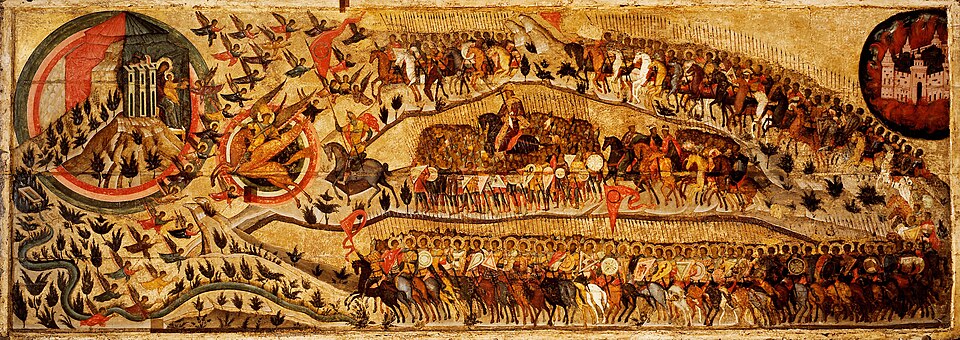
The tradition’s images are evidence, and on this topic they are unusually plain. When the tradition wants to picture the Church on earth, it pictures her as an army. Blessed Be the Host of the King of Heaven, a Russian icon of about 1550–1560 attributed to Athanasius, Metropolitan of Moscow, commemorates Ivan IV’s conquest of Kazan in 1552. A vast host of haloed warriors marches across the panel toward the heavenly Jerusalem; the Archangel Michael leads in a red mandorla; Ivan the Terrible rides in the ranks behind him; the conquered city burns at the top right; in the roundel at the top left, Mary — the one the Orthodox Church calls the Mother of God — with the infant Jesus outside the heavenly gate, distributes crowns to messenger angels who reward the martyrs of Ivan’s army. The icon hung beside the royal seat in the Dormition Cathedral of the Moscow Kremlin. The Church militant is pictured as an actual army, with a tsar in the ranks and a conquered city burning behind it. The icon does not distinguish the Church’s warfare from the empire’s: the martyrs rewarded with crowns are the soldiers of Ivan’s campaign.
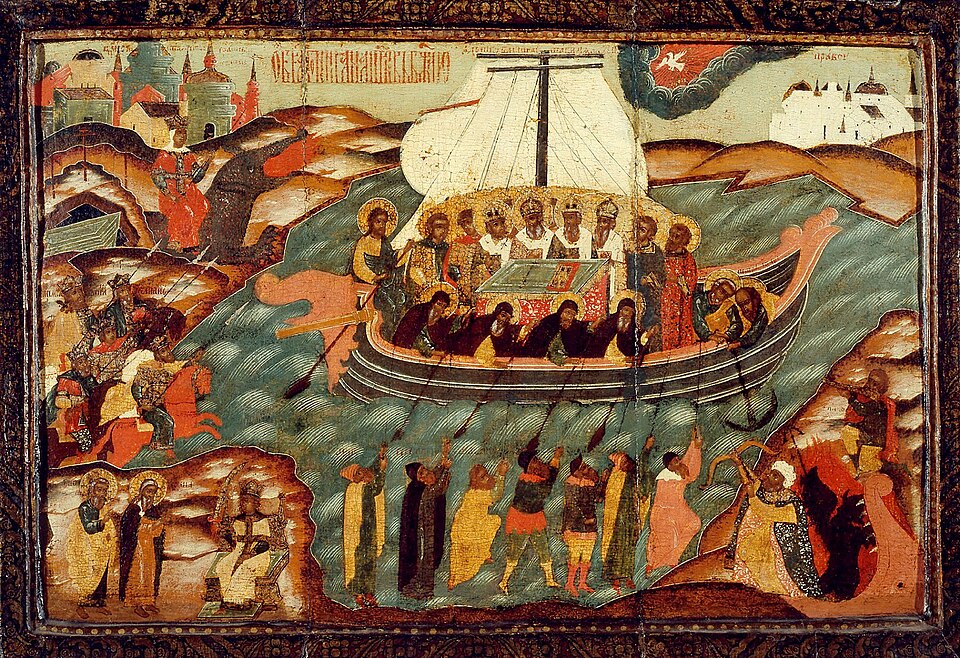
Or the Church is a ship. The Ship of Faith, a Russian icon of about 1700 whose own title is “Image of the persecution of the church of God,” shows Christ at the helm steering; Peter and Paul lifting the anchor; the Holy Fathers surrounding an altar amidships; four monks rowing; the Holy Spirit as a dove above; the white city, the New Jerusalem, at the top right. Outside the hull: heresiarchs attacking on horseback, heretics below with hooks trying to capture or capsize the ship, and at the bottom right a turbaned heretic shooting arrows and Luther firing at the ship with a musket. The prototype of this icon is the early nineteenth-century Bulgarian icon at Zographou Monastery on Athos, which updates the cast of attackers — including a dragon labelled “Nea Epokhi,” “Modernity” — and modern printed versions circulate today with labelled enemies: Luther, the Popes, Ecumenists, the New Age, the Antichrist. Inside the ship: Christ, the apostles, the Fathers at the altar, monks at the oars. Outside: everyone else, with weapons. The picture teaches the boundary doctrine more plainly than any canon: salvation is inside the hull, and the people inside are clergy, Fathers and monks. The ordinary believer is not pictured at all — he is presumably below deck, or he is the audience being warned not to climb out.
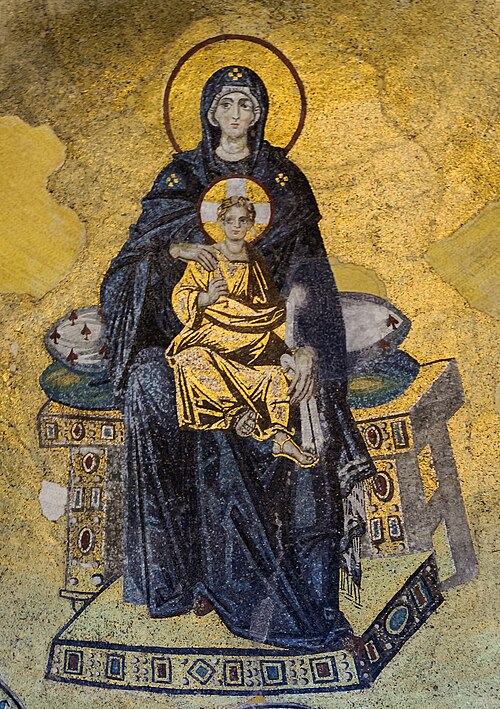
Or the Church is pictured at the liturgy’s centre, in the apse above the altar. The mosaic unveiled in Hagia Sophia in 867 — with a homily by Photios, the programmatic statement of the restored image cult after Iconoclasm — shows Mary enthroned frontally on a jewelled throne, the Christ Child on her lap, on a gold ground, in the semi-dome directly above the altar space. The related type, the Platytera (“more spacious than the heavens”), has been standard in the apse since the ninth century: the dome is heaven, the nave earth, and the apse, where heaven bends down to meet the altar, belongs to the Incarnation — to the woman through whom God entered the world, presiding over the liturgy as the bridge between the two realms, the same Christ contained in her womb contained on the altar below. The Church’s image of herself at the liturgy’s centre is not the congregation, and not even Christ alone, but Mary containing Christ, enthroned over the altar. The people below look up at her.
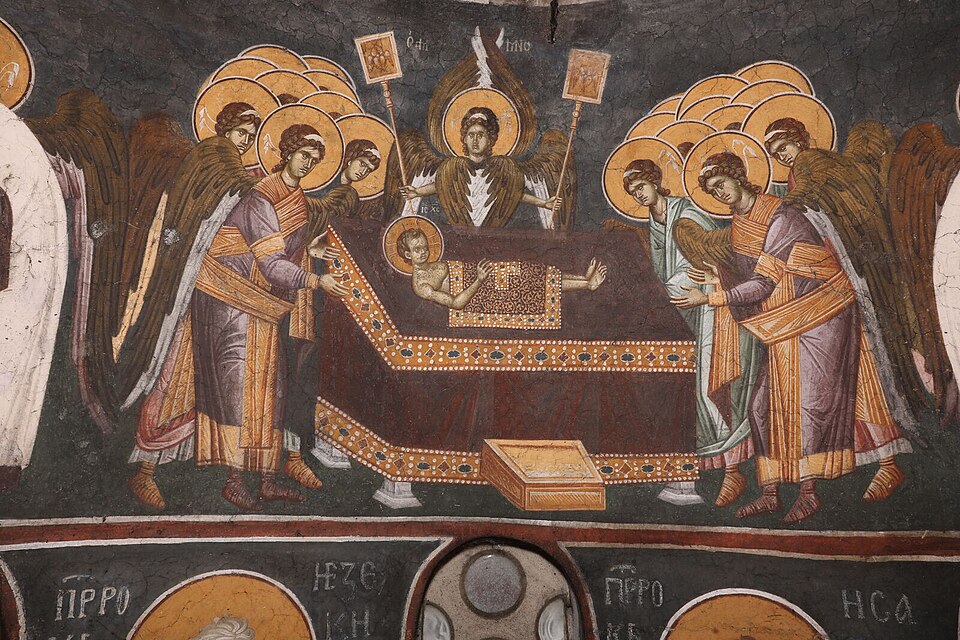
Or the liturgy is celebrated in heaven, by clergy. The main dome of Gračanica Monastery in Serbia, painted about 1320, shows angels in deacons’ vestments, oraria over their shoulders, gathered around an altar on which the Christ Child lies on the paten under the veil — Christ as the Lamb — with a seraph behind holding liturgical fans. The earthly liturgy below mirrors this one: “We who mystically represent the Cherubim.” In heaven, the liturgy is celebrated by clergy — angels vested as deacons around an altar. The earthly liturgy is their icon. The congregation’s part, in the picture and in the service, is to watch the clergy do on earth what the angels do in heaven. There is no image in the tradition of the whole people offering the sacrifice together; the offering is always in clerical hands, on earth as in heaven.
One more image belongs here. The Pokrov — the Protection of Mary, whom the Orthodox Church calls the Mother of God — shows the vision at Blachernae: Mary spreading her veil over the people at prayer. In the Novgorod icon of 1399 she stands on a cloud in prayer, the red veil arched above her in the hands of two angels, Christ overhead, hierarchs at the altar, apostles below, Andrew the Fool pointing out the vision; in the Suzdal icon of the 1360s she holds the veil herself. The Church pictured as a people sheltered under a veil held over them — protected, gathered, covered — by a figure who is not Christ and not the congregation.
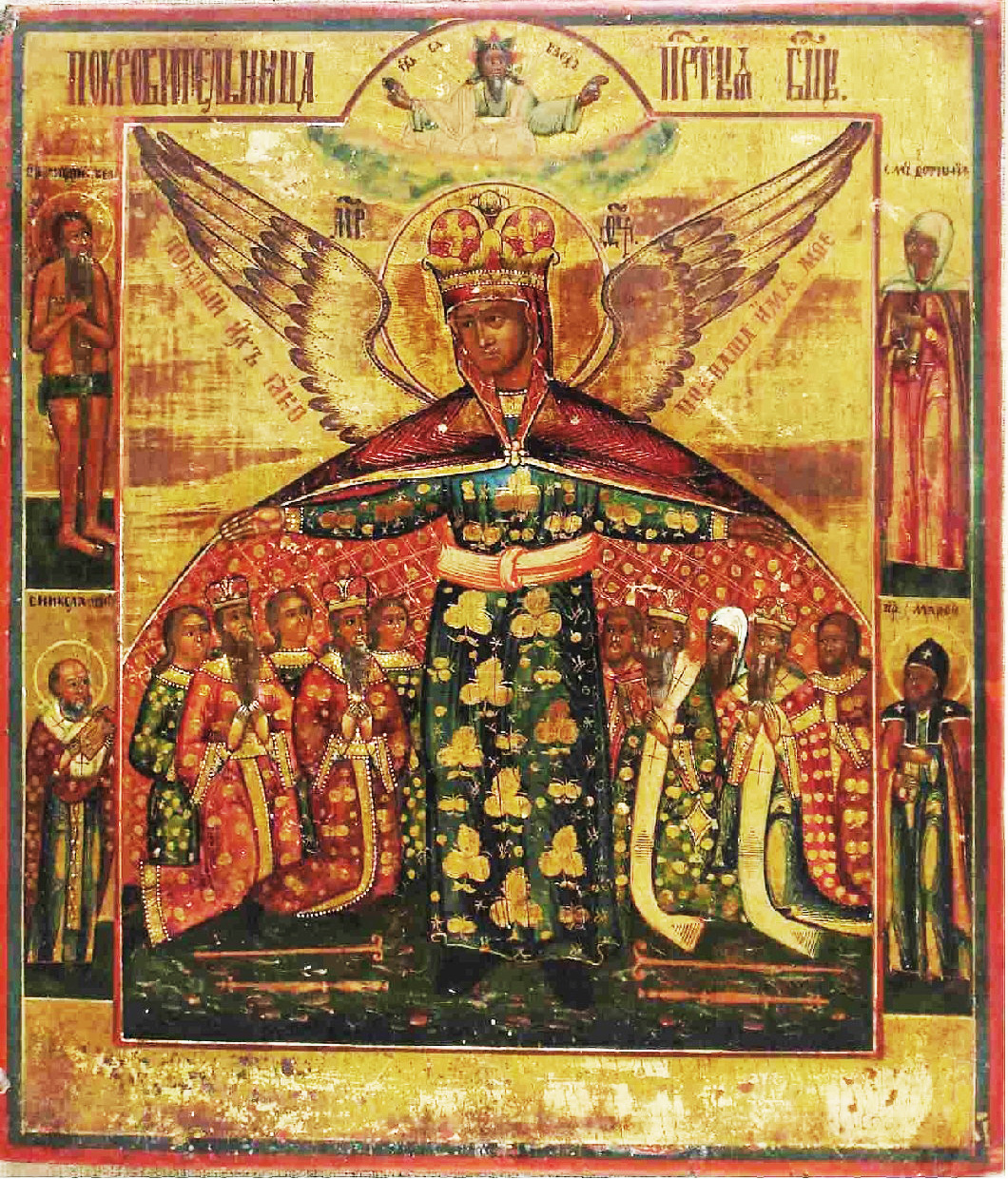
And what does the tradition never picture? No icon of the local congregation as the Church. No image of believers breaking bread in a house (Acts 2:46). No church gathered with no bishop, no priest, no altar screen. No picture of the royal priesthood of all believers (1 Peter 2:9) offering its spiritual sacrifices. In the army icon the people are soldiers under a tsar; in the ship they are absent or below deck; in the apse they look up at the Mother; under the veil they are covered; in the heavenly liturgy they watch the angels. The visual tradition embodies the doctrine exactly: the Church is Christ, Mary, the Fathers, the clergy and the angels — and the people are those whom these carry, cover, lead and feed. What the New Testament pictures — a body of members, each gifted, each a priest, gathered in homes around a table — the iconography has no image for. That absence is drawn from the tradition’s own walls.
5. What the people believe
Start where the people start: at the door of the building. The tradition’s own story of how a nation chose the faith is the story of Vladimir’s envoys, sent in 987 to examine the religions, and it is told in the Primary Chronicle — a compilation of the twelfth century, two centuries after the events, and this piece presents it as what it is: the tradition’s own story about itself. The envoys report on the Greeks: “Then we went on to Greece, and the Greeks led us to the edifices where they worship their God, and we knew not whether we were in heaven or on earth. For on earth there is no such splendour or such beauty, and we are at a loss how to describe it. We know only that God dwells there among men, and their service is fairer than the ceremonies of other nations. For we cannot forget that beauty.” Of the Germans: “we beheld no glory there.” And the chronicle itself says how the spectacle was arranged: the emperor “directed him to prepare the church and the clergy, and to array himself in his sacerdotal robes, so that the Russians might behold the glory of the God of the Greeks... The emperor accompanied the Russians to the church, and placed them in a wide space, calling their attention to the beauty of the edifice, the chanting, and the offices of the archpriest and the ministry of the deacons, while he explained to them the worship of his God.” The faith was chosen for the splendour of the service, staged by an emperor, judged by envoys who compared religions the way one compares ceremonies. The story does not need to be mocked. It needs only to be asked what kind of Church is founded, in her own telling, on being beheld.
The teaching to the people today is the same. The Greek Orthodox Archdiocese’s own visitor material says: “In the Orthodox tradition there is a very strong feeling that the church is the ‘House of God’ and the ‘place where His glory dwells’... all Orthodox churches are blessed, consecrated and set aside as sacred space designed for worship. The whole church bears witness to God’s dwelling among His people.” A GOARCH parish explanation of the interior of Orthodox churches quotes the old admonition: “Let the Christian consider well when he enters the church that he is entering another heaven. That same majesty of God which is in heaven is also in his church, and on this account the Christian must enter with reverence and awe.” For the simple believer, “the Church” is first of all the building he enters — consecrated, set aside, another heaven — with the iconostasis between him and the altar, the dome above him, the priest behind the screen. The doctrine says the Church is not the institution and cannot be identified with her earthly members and institutions. The practice teaches the opposite every Sunday. Both statements stand side by side, and the question is which one the people have been taught.
The ship does the rest of the teaching. A saying handed down under St Seraphim of Sarov’s name — the attribution is reported, not verified, and this piece states it so — puts the popular form of the doctrine in one picture: “I beg and implore you to go to the (Orthodox) Church. It is in all the power and glory of God! Like a ship with many masts, sails and a great helm. It is steered by the Holy Spirit. Its good helmsman are the doctors of the Church. The archpastors are the successors of the Apostles. But your chapel is like a small rowing-boat without rudder and oars; it is secured to the ship of our Church, and floats behind it. The waves wash over it, and it would have certainly gone down if it had not been secured to the ship.” The evangelical chapel as a rudderless boat towed behind the great ship: outside the hull, the water. That is what the people are taught to believe about everyone else — and about themselves: stay in the boat, hold on to the ship, do not climb out.
The reply comes quickly: this is folk piety, not the Church’s teaching; the books say otherwise. It fails here for a reason specific to this case. The building is not a folk invention. It is blessed and consecrated by the Church’s own rite, explained to visitors by the Church’s own archdiocese, and entered under the Church’s own admonition that it is another heaven. The conversion story is not a folk tale the Church disowns; it is the tradition’s own account of how the Church wins nations, printed in her own chronicle. The ship is not a peasant copy; it is on the walls and in the printed icons the Church sells and blesses, with the enemies labelled. And the doctrine that the Church is not the institution is taught in the same books that teach the people to enter the building as another heaven. The gap between the two is where simple people actually live: they are told the Church cannot be identified with her institutions, and they are taught every Sunday that the Church is the building, the priest and the calendar. A teaching that must be withdrawn every time it is judged, and applied every time it is honoured, is not protecting the Church’s mystery. It is protecting the claim.
6. What remains
What stands, after all this, is Christ’s promise. “I will build my church, and the gates of hell shall not prevail against it” (Matthew 16:18). The promise has never failed. It is kept wherever Christ’s people are — in every century in which the visible institutions were corrupt, divided, or both. What does not stand is the claim that the promise is a certificate for the institution that claims the name. The Church that cannot be defined cannot be tested; the Church of the New Testament can be recognised — by the apostles’ teaching, the fellowship, the breaking of bread and the prayers (Acts 2:42); by the Spirit who baptises into one body (1 Corinthians 12:13); by the royal priesthood of the whole people (1 Peter 2:9); by two or three gathered in Christ’s name (Matthew 18:20); by a pillar that holds up a truth it does not own (1 Timothy 3:15).
The claim is applied when the institution is honoured and withdrawn when it is judged. That is the pattern, and it is the Church’s own record that shows it: the claim stated by her theologians, the councils written by her synods, and the record kept by her own history. Scripture does not need the councils to reach the verdict — “in one Spirit we were all baptized into one body” was enough — but it is worth noting that on this question the councils reached it too, and then did not keep it. The Church knows the claim. Her own history does not keep it. The door stands open to every Orthodox reader who wants to test the claim by the Scripture the Church herself says she upholds.
Sources. Scripture quotations follow the English Standard Version, verified at BibleGateway. The teaching at its strongest: Thomas Hopko, The Orthodox Faith, vol. 1, “The Doctrine of Church” (read at churchmotherofgod.org, sourced from the OCA series) and “The Orthodox Parish in North America” (2002, OCA 13th All-American Council); Sergius Bulgakov, The Orthodox Church (English translation at holytrinitymission.org, which states the text was edited by Bishop Alexander Mileant — short sentences quoted); Metropolitan Anthony Bloom, “The Church: an Extension of the Incarnation” (Geneva, 1967, in The Living Body of Christ); Alexei Khomiakov, A Few Words of an Orthodox Christian on the Western Confessions, as quoted in Fr. V. Potapov, “The Roman Catholic Theory on the Development of Dogma and the Problem of Ecclesiastical Authority”; Nikolai Berdyaev on Khomiakov (1912), reported via secondary quotation. The official statements: OCA Holy Synod encyclical, “On Christian Unity and Ecumenism” (oca.org); the Chambésy draft of “Relations of the Orthodox Church with the Rest of the Christian World” (adopted by the 5th Pan-Orthodox Pre-Council Conference, 10–17 October 2015; read in full at mospat.ru) — §§1, 6, 20, 22 quoted from the draft and labelled as such; the adopted Crete §6 (“her unity can never be perturbed... accepts the historical name”) confirmed word for word across multiple independent publications of the adopted text, including the Serbian Orthodox Church’s official site and GOARCH — the official adopted PDF at orthodoxcouncil.org was not read directly; the forty-five-year trajectory of the wording (1971–2016) is reported from the Review of Ecumenical Studies study’s table of the pre-conciliar drafts, and the Greek word rendered “non-Orthodox” is “heterodox” (Paulist Fathers). The patristic anchors: Ignatius of Antioch, Letter to the Smyrnaeans 8 (Lightfoot translation, CCEL); Irenaeus, Against Heresies III.24.1 (Roberts–Rambaut translation, ANF I); Cyprian, On the Unity of the Church 6 and Letter 73.21 (Wallis translation, ANF V; Latin text CSEL 3,2,795) — Cyprian’s original targets (the Novatian schism, heretical baptism) are stated in the text; the modern softening from Protopr. Michael Voskos, “Extra Ecclesiam nulla salus,” Theologia 96/1 (2025). The hospital: John Chrysostom, On Repentance, homily 3 (PG 49) — only the short verified core is quoted; the longer form circulating online is a modern composite (Howry’s tracing), and the Sources note states it so; Canon 102 of the Council in Trullo (OCA text; NPNF Percival translation).
The cases: reception of converts from the jurisdictions’ own guidance — GOARCH (chrismation for properly baptized converts; Metropolitan Maximos of Pittsburgh, 1997 memorandum), the Antiochian Archdiocese, and ROCOR’s Council of Bishops, Montreal, 15/28 September 1971 (text at rocorstudies.org); the history from Heith-Stade (2010) and Dragas — Constantinople 1484 (chrismation), Moscow 1667 (rebaptism), the Horos of Cyril V, 1755 (Dragas’s translation; Heith-Stade, Ostkirchliche Studien 59/1 (2010), pp. 99–110) — the claim that the 1755 Horos is “the last official decision” comes from an Old Calendarist source and is not used. Crete 2016: the four absent churches and their reasons, Archbishop Job Getcha’s “binding on all,” Antioch’s “not binding,” and the Russian Synod’s statement are verified from contemporary reporting and the synods’ own statements; attendance figures differ by source and no number is given; the ROCOR Holy Synod’s pre-conciliar statement from pravoslavie.ru. Moscow–Constantinople: the severance of communion (15 October 2018), the Ukraine tomos (5 January 2019), and the recognitions by Greece, Alexandria and Cyprus are verified; the schism is ongoing as of November 2026. The Old Believers: Nikon’s reforms, Stoglav 1551, the Great Moscow Synod 1666–67, the 1685 decrees, and the lifting of the anathemas in 1971 (ROCOR 1974) are verified; the allegation that the visiting patriarchs in 1666 received bribes is an allegation (Zenkovsky) and is excluded.
The iconography: Blessed Be the Host of the King of Heaven (mid-16th century, Tretyakov Gallery, accession 6141; public domain, Google Art Project); Ship of Faith (about 1700, Tretyakov; public domain), with the Zographou prototype (1817) and modern printed versions as described on the Commons file page; the Hagia Sophia apse mosaic (unveiled 867; photograph by Myrabella, CC0) and the Platytera type; the Heavenly Liturgy, Gračanica main dome (about 1320; photograph by BLAGO Fund, Inc., CC BY 4.0 — credit in the caption). The Pokrov is described from verified secondary descriptions (Novgorod 1399; Suzdal 1360s); the figure is a Russian icon of the Protectress (Wikimedia Commons, public domain). What the people believe: the Primary Chronicle (the Tale of Bygone Years, compiled in the 12th century, describing 987; Cross/Sherbowitz-Wetzor translation via UNCG) — presented as the tradition’s own story, not as a contemporary record; GOARCH, “What to Expect When Visiting an Orthodox Christian Church”; Rev. Thomas Fitzgerald, “House of God: An Explanation of the Interior of Orthodox Churches” (GOARCH parish site). The Germanus of Constantinople “heaven on earth” quotation came from a weak source and was not verified; it is not used. The Seraphim of Sarov ship saying is reported from a parish page; its attribution is unverified and is stated so in the text. Charalampakis’s Letter 28 (“On the Church”) was read at its opening in the book text; the survey’s report that he quotes Athenagoras approvingly could not be verified from the text layer, and no Charalampakis material is used. Kallistos Ware’s The Orthodox Church was not read directly and is not quoted. Full research notes: ~/workspace/research_notes/orthodox-church-20261126/report.md.
Related reading: The priesthood of all believers · What Orthodoxy teaches about Scripture and Tradition
Researched and drafted with the help of Muse, an AI assistant. Every claim is checked against its sources, and every article is approved by Aris Angelakopoulos before publication.