What Orthodoxy teaches about Mary's children
The Gospels name them. In Nazareth, the crowd asks: “Is not this the carpenter’s son? Is not his mother called Mary? And are not his brothers James and Joseph and Simon and Judas? And are not all his sisters with us?” (Matthew 13:55–56). Four brothers, named, and sisters besides — and they are named in the same breath as their mother.
The Orthodox Church says they were not Mary’s children. The teaching is the ever-virginity of the Theotokos: Mary was a virgin before, during, and after the birth of Christ. So the brothers must be someone else — and the Church has given two answers that disagree with each other: Joseph’s children by a former marriage, or cousins. The question this piece examines is which answer the texts support — and what it means that the Church has never settled on one.
The three historic answers have names, given by J. B. Lightfoot in 1865 after their fourth-century advocates. The Helvidian answer: the brethren were Mary’s later children by Joseph. The Epiphanian answer: Joseph’s children by a former marriage, older step-brothers. The Hieronymian answer: cousins, sons of Mary of Clopas.
1. What the Gospels say
The strongest single text is Mark 6:3. Jesus is identified as “the carpenter, the son of Mary and brother of James and Joses and Judas and Simon” — sonship to Mary and brotherhood to the four named brothers predicated of the same person in the same clause. Matthew’s parallel (13:55–56) names the mother first, then the brothers, then “all his sisters” — at least two.
The pattern holds everywhere the brothers appear. They are introduced in immediate conjunction with “his mother”: “his mother and his brothers stood outside, asking to speak to him” (Matthew 12:46); “he went down to Capernaum, with his mother and his brothers and his disciples” (John 2:12); “together with the women and Mary the mother of Jesus, and his brothers” (Acts 1:14). Mother and brothers, as a family unit, in every instance.
Paul’s testimony is earlier than the Gospels and independent of them. In Galatians, written about AD 48–49, he writes of “James the Lord’s brother” (Galatians 1:19) — the earliest New Testament reference to a brother of Jesus. In 1 Corinthians he groups “the brothers of the Lord” as a recognised body alongside “the other apostles” and Cephas (1 Corinthians 9:5).
One honest point cuts both ways. No New Testament passage expressly calls any brother or sister of Jesus a child of Mary. But no passage calls them Joseph’s children by a former marriage either, and no passage calls them Mary’s nephews. Jerome saw this himself: the Scripture “calls them neither sons of Mary, nor of Joseph.” The New Testament does not settle the question by direct statement — which is why the whole argument turns on inference from the word choice, the groupings, and the patristic witness.
The texts, read together, do not merely permit the literal reading. They point to it, and every alternative requires importing something the text does not supply. No passage anywhere in the New Testament calls any of them a cousin, a step-brother, or anything else. The burden is not on the plain reading. It is on the reading that needs the words to mean something other than what they say.
2. The word for cousin
Greek had a word for cousin: ἀνεψιός. It occurs exactly once in the New Testament — Colossians 4:10, “Mark the cousin of Barnabas”. The Gospels never use it. Every New Testament reference to Jesus’ brothers — Matthew, Mark, Luke, John, Acts, 1 Corinthians, Galatians — uses ἀδελφός, brother.
Paul is the decisive case. He uses ἀνεψιός for a cousin (Colossians 4:10) and ἀδελφός for James the Lord’s brother (Galatians 1:19). The same author, writing in Greek, had both words and used them for different relationships — and this cannot be explained away as translation from Aramaic.
Hegesippus, writing about AD 160, does the same — James the Lord’s ἀδελφός, Symeon son of Clopas the Lord’s ἀνεψιός: two different words for two different relationships.
The word was available to Greek-speaking Jews long before the Gospels. The Septuagint uses ἀνεψιός at Numbers 36:11, where the daughters of Zelophehad marry their ἀνεψιοί. Liddell and Scott give “first cousin, or generally, cousin”, and the papyri confirm the cousin sense in ordinary Koine of the second and third centuries; the “nephew” sense is later. Two other Greek kinship words were available: συγγενής, “relative” — Luke uses it when Elizabeth is Mary’s “relative” (Luke 1:36) — and ἐξάδελφος, “nephew”. The evangelists used none of them for Jesus’ brothers.
Tobit uses ἀδελφός for a cousin too: Raguel calls Tobit ἀνεψιός (Tobit 7:2) and then “our brother” (Tobit 7:4). But the counterweight has its own limit: the context. In every case where ἀδελφός is used loosely, the context supplies the precise relationship: Lot is called Abraham’s “brother” in Genesis 13:8, but the narrative has already told the reader he is Abraham’s nephew (Genesis 11:27); Raguel calls Tobit “brother” in Tobit 7:4, but he has already identified him as his ἀνεψιός in 7:2. And the Gospel context does the same work in the other direction: mother and brothers named together as a family unit, the crowd arguing from intimate local knowledge, Paul choosing ἀδελφός for James when he had ἀνεψιός in the same vocabulary. Nothing in the context signals cousins or step-brothers; everything in it signals brothers.
The strongest reply from the cousins side is the “mixed group” one: if the four brothers were not all cousins in the same degree, no single precise term would cover them all, and ἀδελφοί was the only word that would. The reply is fair as far as it goes, but it concedes the point it is meant to answer: the cousin theory alone cannot explain the word choice, and the mixed-group hypothesis has no direct evidence behind it.
If ἀδελφοί meant cousins in the loose sense, the category would be much wider than four men and their sisters. John the Baptist was the son of Elizabeth, Mary’s relative (Luke 1:36) — by tradition, Jesus’ cousin — yet he is never called Jesus’ brother anywhere in the New Testament. James and John, the sons of Zebedee, would be Jesus’ cousins too if their mother Salome was Mary’s sister, as the four-women reading of John 19:25 holds — and they are never called His brothers either. The word, in its family sense, is used for exactly four men and their sisters, and for no other relative of Jesus. That selectivity is hard to explain if the word is loose. It is exactly what you would expect if it means what it says.
The Hebrew background is real but does not settle it. Hebrew has no single word for cousin, and Aramaic likewise. That explains why ἀδελφός could mean cousin in Semitic-influenced Greek. It does not explain why the evangelists and Paul would use it for cousins when ἀνεψιός was at hand. And Jerome, who invented the cousins theory, never addressed the point in his treatise against Helvidius — the word’s availability is the one argument he does not meet.
3. The two explanations
The step-brother view is the older of the two. It comes from the Protoevangelium of James, a second-century apocryphon, in which Joseph is an elderly widower with children, chosen by lot to guard Mary. Origen, the earliest Father to discuss the question, traces the view to its source with candour: it comes from “a tradition in the Gospel according to Peter… or ‘The Book of James’” — apocrypha, endorsed by Origen on reasoning, not on apostolic tradition. Epiphanius, writing against the Antidicomarians — the sect that held Mary had children by Joseph after Jesus — gives the fullest patristic statement of the step-brother view.
But the apocryphal details disagree with each other. Epiphanius names six step-children and puts Joseph over eighty. The History of Joseph the Carpenter names a different six, puts Joseph at ninety — and makes James one of the younger sons where Epiphanius makes him Joseph’s first-born. The framework is stable — Joseph an elderly widower with children. The particulars vary.
The cousins view is Jerome’s novelty, and the evidence for that is Jerome himself. Lightfoot: “there is not the slightest indication that the Hieronymian solution ever occurred to any individual or sect or church, until it was put forward by Jerome himself.” Jerome names no predecessor for the relationship — only for the virginity — and in De viris illustribus he presents the cousins view as his own opinion, “as appears to me”. The Alphaeus = Clopas equation on which the mature theory depends was not even Jerome’s; as Lightfoot notes, it first appears in Chrysostom.
The cousins theory rests on an identification no Gospel ever states: that Mary the wife of Clopas (John 19:25) is the same woman as Mary the mother of James and Joses (Matthew 27:56; Mark 15:40). Same scene, same position in the list, matching names — the most economical harmonisation of the cross lists. But the lists do not line up neatly: Luke adds Joanna, whom Matthew and Mark omit; and John 19:25 is genuinely ambiguous — “his mother and his mother’s sister, Mary the wife of Clopas, and Mary Magdalene” may name three women or four. Jerome himself hedged on the identification his theory depended on: “I do not wish to argue for or against the supposition that Mary the wife of Clopas and Mary the mother of James and Joses were different women.” And the identification, even if it holds, establishes only that two of the four brethren had another mother — Simon and Jude are never called sons of Mary of Clopas anywhere. The extension to all four is an inference from an inference.
The two explanations cannot both be true. The Eastern tradition holds the step-brother view; the Western tradition, following Jerome, holds the cousins view. Modern Orthodox authorities list both and commit to neither: Ware says the brothers “may be… half-brothers, born to Joseph from a previous marriage; also the word… can mean cousin or other close relative”, and Hopko says they “were not children born of Mary… but were either cousins or children of Joseph.” The dogma is the negative — not Mary’s children. The positive identification is left open.
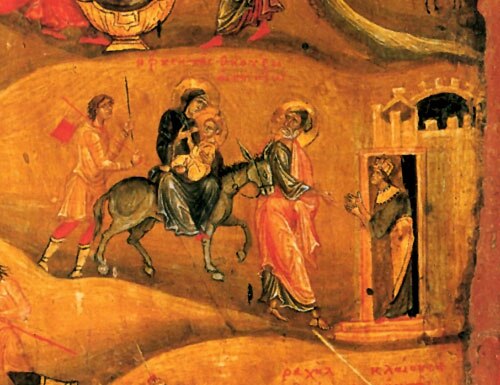
The iconography, though, has chosen. In the Flight into Egypt, James walks with the Holy Family — as Joseph’s son, not as Mary’s. The icon below is a detail of the eleventh-century Nativity icon at St Catherine’s Monastery, Sinai. The visual tradition pictures what the Church teaches — and it has no image of Mary with the brothers as her own children.
The Church must choose, and it has never chosen. Either the brothers were Joseph’s children by a former marriage — a view resting on apocrypha whose details disagree with each other — or they were cousins — a view invented in the fourth century by a man who hedged on the identification it depended on. There is no third explanation on offer. A dogma that says what the brothers were not, but cannot say what they were, is a dogma about a gap.
4. “Until” and “firstborn”
Two words carry the evangelical case, and both need care. The first is Matthew 1:25: “but knew her not until she had given birth to a son.” The English Standard Version has no “firstborn” here — the critical text reads “a son”; the Textus Receptus reading, “her firstborn son”, was imported from Luke 2:7, where πρωτότοκον is unchallenged. The “firstborn” argument belongs to Luke 2:7: “she gave birth to her firstborn son.”
The Orthodox reply on “firstborn” is the strongest lexical argument on its side — and it still requires reading a birth narrative as a legal text. In the biblical idiom, “firstborn” can be a status, not a sequence: Exodus 13:2 defines it as “the first to open the womb”, and Hebrews 1:6 calls the only-begotten Son “firstborn”, a titular use with no siblings implied. That is true. But the legal uses define a criterion for consecration, and the titular uses are Christological — neither determines what the word means in a birth narrative. Luke 2:7 is a birth narrative, and in a birth narrative “firstborn” naturally implies later children. The strongest form of the reply is the presentation that follows (Luke 2:22–24 cites the law of the firstborn) — a genuine connection. But the word is used at the birth, and the narrative sense is primary. Matthew, writing about the same birth, says simply “a son” — Luke chose the word with the sequential sense.
The strongest form of the reply goes further. Scripture calls Jesus both the Father’s firstborn — “the firstborn of all creation” (Colossians 1:15), “the firstborn among many brothers” (Romans 8:29) — and the Father’s only-begotten (John 3:16). If “firstborn” implied later children, the Father would have other sons. So “firstborn” does not by itself imply others, and the word in Luke 2:7 cannot carry the argument alone. That is fair. But the two cases differ in exactly the way that matters. The Father’s “firstborn” is titular — a theological claim about pre-eminence — and it is clarified by the “only” stated alongside it. In Mary’s case, the context is a birth narrative, and no “only” is ever stated.
Luke uses the word μονογενής — “only” — three times in his Gospel, and every time for someone else’s only child: the widow of Nain’s son, “the only son of his mother” (Luke 7:12); Jairus’s daughter, “an only daughter” (Luke 8:42); the boy whose father cries, “he is my only child” (Luke 9:38). Luke had the word for an only child, and he used it. But for Jesus, as Mary’s son, he never used it. He called Him “firstborn” (Luke 2:7) — the word that implies later children — and left “only” for the Father’s Son (John 1:14; 3:16). No one in the New Testament — not Mary, not Luke, not Paul, not John — ever calls Jesus Mary’s only son. The word was there. No one used it.
The “until” reply is weaker than it looks, and the Orthodox side’s own witness says so. Jerome’s argument is that ἕως οὗ does not entail a change afterwards: Michal “had no child to the day of her death” (2 Samuel 6:23); Christ is with His disciples “to the end of the age” (Matthew 28:20); the Son reigns “until he has put all his enemies under his feet” (1 Corinthians 15:25). The narrow point is true — the word does not entail a change. But his examples do not show what he needs them to show. In every one of them, the “until” marks a real boundary after which the situation changes: Michal’s is bounded by death; Christ’s presence “to the end of the age” is bounded by the eschaton; the Son’s reign “until” the enemies are subjected ends in the delivery of the kingdom to the Father (1 Corinthians 15:24, 28). Jerome needs an example where the state continues unchanged past the boundary. He does not have one. And Charalampakis, arguing for the Orthodox case, notes the weakness himself: in Matthew 28:20 and Matthew 22:44, “a time interval is implied”. The raven of Genesis 8:7, which “went out and did not return until the water dried”, rests on the Septuagint’s wording; the Hebrew says the raven went “going out and returning”.
The Greek sharpens the point without settling it. The verb in Matthew 1:25 is imperfect — οὐκ ἐγίνωσκεν, “he was not knowing her” — a continuing state, bounded by “until”. That does not prove what happened after the end. But it is the natural way to describe a state that ends, and the reading that says it never ended has to explain why Matthew bounded it at all.
The correct conclusion is linguistic, not theological: “until” marks a temporal limit and is silent about what follows; the context decides. Jerome proves the word does not entail a change. He does not prove no change occurred. The context of Matthew 1:25 — the imperfect verb, the birth as the boundary, the ordinary expectations of marriage — points toward change. And the burden runs the other way: “until” and “firstborn”, in their natural sense, point toward later children. The side that needs them to mean something else must show why — and the showing has to come from the text, not from the dogma.
5. The cross
The strongest argument from the narrative is John 19:26–27. At the cross, Jesus said to his mother, “Woman, behold, your son!” — and to the disciple, “Behold, your mother!” And from that hour the disciple took her to his own home. If Mary had four sons and daughters of her own, why would Jesus entrust her to a non-relative? Jerome put it sharply: “as if upon your own showing, she had not four sons, and numerous daughters?”
The counter-argument is fair. John 7:5: “For not even his brothers believed in him.” The brothers were unbelievers at the time; Jesus entrusted his mother to a believer, not to unbelievers.
Lightfoot’s permanence point is the argument’s strongest form. Acts 1:14 shows the brothers as believers, praying with Mary in Jerusalem after the resurrection — yet Mary remains John’s charge. If the entrusting were only about unbelief, it would have been reversed when the brothers believed. It was not.
But the argument has limits. Bauckham, who holds the Epiphanian view himself, calls it “beside the point” — a theological tableau, not a family-law arrangement. McGiffert, who calls it “the only serious objection” to the Helvidian reading, answers it by noting that John was, on the usual harmonisation, Jesus’ cousin.
John 19:26–27 is a genuine presumption, not a proof — and pressed to its conclusion, it creates a dilemma for the Orthodox side. If the entrusting proves Mary had no sons at all, it proves too much: it defeats the step-brother view as well, since step-sons living in the same household would equally have owed her care. If it proves only that she had no sons of her own, then it is a presumption about the household, not a proof about the womb — and a presumption John 7:5 answers. Either the argument is strong, and the East’s own view falls with the Helvidian reading, or it is weak, and it does not defeat the Helvidian reading at all.
6. James the Just
James is the anchor of the whole question, and his standing in the early church is not in doubt: he speaks last at the Jerusalem Council and proposes the settlement the council adopts (Acts 15:13–20); he is named first among the “pillars” — James, Cephas, John (Galatians 2:9); the risen Christ appeared to James individually (1 Corinthians 15:7).
The outside witness is Josephus. In Antiquities 20.9.1, describing the year AD 62, he writes that the high priest Ananus brought before the Sanhedrin “the brother of Jesus, who was called Christ, whose name was James”, and “delivered them to be stoned”. The passage is accepted as authentic by the large majority of scholars — it stands in all three principal Greek manuscripts and in the sixth-century Latin translation, and its sceptical phrasing, “who was called Christ”, is not how a Christian interpolator would write. A small dissent exists, restated as recently as 2025. But the consensus stands: a non-Christian historian, writing within living memory of the events, calls James the brother of Jesus.
Josephus is the more telling witness because he had both words and used them distinctly: ἀνεψιός for cousins, ἀδελφός for James. A first-century Jew writing in Greek, with no dogmatic interest in the question, called James the brother of Jesus.
Hegesippus, writing about AD 160 and quoted by Eusebius, calls James “the Just”. And his language is the language of real kinship: Jude’s grandsons, brought before Domitian, were “the grandsons of Jude, who was said to have been the Lord’s brother according to the flesh.”
One caution belongs here. Josephus and Hegesippus contradict each other on James’s death: Josephus has a judicial stoning in AD 62, by the high priest Ananus with the Sanhedrin; Hegesippus has a mob killing about AD 69, by Pharisees and scribes, from the pinnacle of the temple. They agree on the name, the stoning, and Jerusalem — and disagree on date, manner, and opponents. No harmonisation is in the sources, and this piece does not invent one.
7. The Fathers
The patristic record does not show the unanimity the dogma implies. Tertullian, the earliest Father whose view is clear, held the Helvidian position — more than a century and a half before Helvidius. In De carne Christi he writes that Mary “was a virgin when she conceived, she was a wife when she brought forth her son”, and in De monogamia that she was “about to marry once for all after her delivery”. His point was Christological: Mary was a real mother, with a real birth, against the docetists.
Origen refuted the same position 150 years before Helvidius — which shows it was already a live question in the third century. In his Homilies on Luke he writes that “those sons who were called Joseph’s were not born of Mary, nor is there any Scripture that records such things.” And in the fourth century the Antidicomarians held that Mary had children by Joseph after Jesus; Epiphanius wrote his Panarion 78 against them.
Jerome’s claim, in chapter 18 of his treatise against Helvidius, that no one had held Helvidius’s view before him is false on Tertullian alone. His dismissal — that Tertullian “did not belong to the Church” — is an evasion, not an argument. And his rejection of the step-brother view as apocryphal “invention” cuts both ways: the view he rejected was the one the Eastern Church held, and the one Origen had endorsed. Jerome replaced an apocryphal tradition with a novel inference — and added a further novelty, arguing that Joseph too remained a virgin, a claim no earlier Father had made.
The Helvidian reading is not a Reformation invention, either: Luther and Zwingli both affirmed the perpetual virginity — Luther, that “the Virgin Mary bore no children besides Him”; Zwingli, that she remained “a pure and spotless virgin, for eternity”.
And one of the Fathers conceded the point outright. Basil of Caesarea, in his Homily on the Holy Birth of Christ, allowed that even if Mary had not refrained from normal married life after the birth, it would not have affected the teaching of the faith — her virginity was necessary until the Incarnation, and what happened afterward need not be investigated. The attribution was doubted in the eighteenth century and is accepted in modern editions. A Father of the Church, one of the Three Cappadocians, saying the question does not matter for the faith.
Two verdicts from the ablest critics of the cousins theory show the honest state of the evidence. Lightfoot, who held the step-brother view: “taking the scriptural notices alone, the Hieronymian account must be abandoned; while of the remaining two the balance of the argument is against the Helvidian and in favour of the Epiphanian.” McGiffert, the other way: the full-brother reading “rests upon a more natural interpretation of the various passages involved, and would perhaps have been universally accepted had it not been for the dogmatic interest felt by the early Church in preserving the virginity of Mary.” Lightfoot and McGiffert agree that the cousins theory fails on Scripture alone. They disagree on the remaining choice — and that disagreement is the honest state of the evidence.
The chronology tells its own story. The Helvidian reading is the earliest position on record: Tertullian held it in the early third century, and Origen was already refuting it. The cousins view was invented by Jerome in 383. The perpetual virginity itself was not confessed by a council until Constantinople II in 553. The text was written in the first century; the doctrine that re-reads it took nearly five centuries to define. The dogma developed; the text did not change.
8. What the Church says today
The most honest statement of the Orthodox case comes from an Orthodox priest. Charalampakis, in Letter 23 of Anapoda, states the evangelical case fairly first — the brothers living with Mary, the Gospel passages — and then sets it aside explicitly “for dogmatic reasons”: the opinion “cannot be accepted” because the dogma excludes it, not because the texts refute it. He presents both Orthodox explanations side by side without reconciling them. He undermines the “until” reply himself. And he concludes by refusing to decide: “It is wise to leave this matter with the big ‘bone’ and to have patience until we reach the Kingdom of the Lord, and then we shall ask the ‘favoured one’.”
The age argument he endorses is suggestive, not decisive: if the four brothers were born after Jesus’ twelfth year, the eldest would be about eighteen and the youngest about ten when Jesus was thirty — yet they speak to him with the commanding tone of guardians (John 7:3). The arithmetic is sound on its premises, but the Gospels never say when the brothers were born, and younger brothers can be bossy.
The modern scholarly consensus favours the Helvidian reading. John P. Meier, a Catholic priest, concluded that the brothers and sisters of Jesus were most probably true siblings — expressly “prescinding from faith and later Church teaching”. Richard Bauckham, who holds the Epiphanian view himself, writes that the Helvidian view is what “probably most modern exegetes, even including some Roman Catholic scholars, hold”, that the cousins view is “least probable”, and that “the historical evidence is not sufficient for a firm decision between the Helvidian and Epiphanian views.” Géza Vermes states it plainly: the brothers and sisters “were the children produced by Joseph and Mary after the birth of Jesus.” The dissent is real and respectable — Lightfoot, McHugh, Blinzler.
Against that, the Church offers a dogma that says what the brothers were not, and two explanations of what they were that contradict each other — one resting on apocrypha whose details disagree, the other a fourth-century novelty whose inventor hedged on the identification it depended on and never met the strongest argument against it. The words “until” and “firstborn” do not decide the question; the cross raises a presumption, not a proof; and the Fathers do not agree with each other.
The question, in the end, is whether the dogma or the text decides. If the text decides, the brothers were Mary’s children — the Gospels name them, Paul calls James the Lord’s brother, Josephus calls him the brother of Jesus, and the word for cousin was there and no one used it. If the dogma decides, then the Gospels must be read against their plain sense, on the strength of two explanations that contradict each other, neither of which the Church has ever chosen. The Church has chosen the dogma. The cost is a reading of the Gospels that the Gospels themselves do not support — and a question its own authorities, ancient and modern, cannot answer: who were the brothers, if they were not her children? Its own priest, Charalampakis, having argued the case at full strength, leaves the matter with the big “bone” and waits to ask the favoured one herself.
Sources. Scripture quotations follow the English Standard Version. The Gospel texts: Mark 6:3; Matthew 13:55–56, 12:46–50; Luke 8:19–21, 2:7; John 2:12, 7:3–5, 19:25–27; Acts 1:14; Galatians 1:19; 1 Corinthians 9:5; Colossians 4:10. On Matthew 1:25: the critical text reads “a son” (Metzger, A Textual Commentary, rating {A}); “her firstborn son” is the Textus Receptus reading, imported from Luke 2:7. On ἀνεψιός: Liddell–Scott–Jones; Moulton–Milligan (The Vocabulary of the Greek Testament); the Septuagint at Numbers 36:11 and Tobit 7:2, 7:4; Hegesippus in Eusebius, Church History III.11, IV.22. The patristic survey: Tertullian, De carne Christi 23 and De monogamia 8; Origen, Homilies on Luke 7 and Commentary on Matthew 10.17; Epiphanius, Panarion 78; Jerome, De perpetua virginitate beatae Mariae adversus Helvidium (383) and De viris illustribus 2; Basil of Caesarea, Homily on the Holy Birth of Christ (CPG 2913) — the attribution was doubted by Garnier in the Maurist edition (1721–1730) and is accepted in modern editions (Vigiliae Christianae 66 [2012]; The Cambridge Edition of Early Christian Writings, 2022); Basil’s concession is summarised here from secondary sources. Constantinople II (553), Anathemas 2 and 6, is the first council to confess Mary “always a virgin”. The apocrypha: the Protoevangelium of James, chs. 8–9, 17–20; the History of Joseph the Carpenter, chs. 2, 4, 11, 14. James the Just: Josephus, Antiquities 20.9.1 (Josephus’s use of ἀνεψιός for cousins elsewhere in the Antiquities and the Wars is documented in the secondary literature); Hegesippus in Eusebius, Church History II.23, III.19–20; Origen, Against Celsus 1.47; Eusebius, Church History II.23.20. The modern discussion: J. B. Lightfoot, “The Brethren of the Lord” (1865); A. C. McGiffert, notes on Eusebius (Nicene and Post-Nicene Fathers); John P. Meier, A Marginal Jew, vol. I (1991) — his conclusion is quoted here from secondary sources; Richard Bauckham, Jude and the Relatives of Jesus in the Early Church (1990) — the John 19 passage is quoted here from a secondary source — and Themelios 21.2 (1996); Géza Vermes, The Nativity: History and Legend (2006); John McHugh, The Mother of Jesus in the New Testament (1975), and Josef Blinzler, Die Brüder und Schwestern Jesu, as reported in reviews. The Reformers: Martin Luther, Sermons on the Gospel of St. John (1537–1540), Luther’s Works, vol. 22, pp. 23, 214, and That Jesus Christ Was Born a Jew (1523), Luther’s Works, vol. 45; Ulrich Zwingli, Eine Predigt von der ewig reinen Magd Maria (September 1522). The Orthodox teaching today: Kallistos Ware, The Orthodox Church; Thomas Hopko, The Orthodox Faith, vol. I. Stylianos Charalampakis, Τα Ανάποδα της Θρησκείας, Letter 23 (pp. 308–314), was used as one resource among others; the book’s argument is presented here as he presents it, including his own criticisms of the “until” reply and his refusal to decide. Full research notes: ~/workspace/research_notes/marys-children-20261124/report.md.
Related reading: What Orthodoxy teaches about Scripture and Tradition · What Orthodoxy teaches about the canon of Scripture · What Orthodoxy teaches about icons
Researched and drafted with the help of Muse, an AI assistant. Every claim is checked against its sources, and every article is approved by Aris Angelakopoulos before publication.