Why the Church holds the ever-virginity
The Orthodox churches teach that Mary was a virgin before, during, and after the birth of Christ — always a virgin. The doctrine is not in Scripture. It was never defined by an ecumenical council. Its first full statement is a second-century apocryphon, its earliest patristic defence argues from piety, and its strongest patristic argument proves the conception and not what followed. The consensus is real, and it is not enough. A doctrine that cannot be shown from Scripture should not be held as dogma.
That is the verdict. What follows is the evidence for it: what Scripture says, where the doctrine comes from, the arguments tested one by one, what the icons show, and what the consensus is worth.
1. What Scripture says
Start with the text, before any Father is quoted. Four words carry the case.
“Until.” Matthew 1:25: Joseph “knew her not until she had given birth to a son”. The word marks a boundary, and in every example Jerome himself cites for it, the boundary marks a real transition after which the situation changes.
“Firstborn.” Luke 2:7: Mary “gave birth to her firstborn son”. In the ESV, Matthew 1:25 has no “firstborn” — the critical text reads “a son”, and “her firstborn son” is the Textus Receptus reading imported from Luke. So the “firstborn” argument belongs to Luke 2:7, and it belongs there in a birth narrative, with no “only” ever stated alongside it.
“Brothers.” Matthew 13:55–56 names them — James, Joseph, Simon, and Judas — and their sisters. The Gospels never call them cousins. The word for cousin existed, and Paul used it for a cousin in Colossians 4:10 while calling James “the Lord’s brother” in Galatians 1:19.
“Only son.” Luke uses μονογενής three times, and every time for someone else’s only child — the widow of Nain’s only son (Luke 7:12), Jairus’s only daughter (Luke 8:42), the demon-possessed boy, his father’s only child (Luke 9:38). He never uses it for Jesus as Mary’s son. No one in the New Testament ever calls Jesus Mary’s only son. The word is used for Jesus only as the Father’s only Son — “the only Son from the Father” (John 1:14), “his only Son” (John 3:16). If Mary had no other children, Luke had the word for it, and he used it for everyone else’s only child but never for hers.
The text does not prove later children — as the Baptist theologian Kevin Bauder concedes, “the evidence is not absolutely conclusive” — but it points that way, and the burden is on the doctrine, which is the positive claim, to show otherwise. And the positive side of the text should be stated too: the incarnate Lord grew up in a normal human family with brothers and sisters, “made like his brothers in every respect” (Hebrews 2:17), and marriage, which God called good and which Hebrews 13:4 honours — “let the marriage bed be undefiled” — is honoured in the Holy Family rather than treated as something the Mother of God must be kept from.
2. Where the doctrine comes from
The doctrine’s first full statement is not in Scripture. It is in the Protoevangelium of James, a second-century apocryphon. Chapters 19 and 20 tell the story of Salome’s test: the midwife doubts Mary’s virginity after the birth, puts her finger to the test, and her hand withers and is healed. The Protoevangelium is the narrative source for virginity in partu — the birth itself leaving Mary intact. It is not Scripture, and the Church has never treated it as such. But the doctrine’s central image comes from it.
The earliest patristic defence comes from Origen, writing in the 240s, and he gives the reason plainly. Those who hold the step-brother view “wish to preserve the honour of Mary in virginity to the end, so that that body of hers which was appointed to minister to the Word… might not know intercourse with a man after that the Holy Ghost came into her and the power from on high overshadowed her”. And then the sentence that shows what kind of argument this is: “it were not pious to ascribe to any other than to her the first-fruit of virginity”. Origen names his sources, and they are apocryphal — the Gospel of Peter and the Book of James — and his own argument is explicitly a judgement of piety, not exegesis of any text.
The councils come late, and they do less than is usually claimed. Constantinople II, in 553, confesses Mary as “Mother of God and always a virgin” inside an anathema about the two nativities of the Word. The council confesses the title; it does not define the threefold formula, and it says nothing about the brethren. The explicit formula comes only at the Lateran Synod of 649, a Western synod under Pope Martin I, two centuries later. The doctrine was confessed before it was defined, and defined by a synod that was not ecumenical.
One word’s history belongs here, because it is often misdated. The word ἀειπάρθενος — ever-virgin — first appears in Athanasius, Against the Arians II.70, around 357 to 360: “let those who deny that the Son is from the Father by nature and proper to His Essence, deny also that He took true human flesh of Mary Ever-Virgin”. It appears not in a treatise on Mary but as a passing epithet in an argument about the reality of Christ’s flesh. The title guards both the true divinity of the Son and the true humanity of His flesh. The same sentence circulates misattributed to “Origen, Commentary on John I:6” — it is Athanasius II.70, and it should never be cited as Origen.
3. The arguments, tested
Consecration. The argument is that Mary’s body was set apart for God, and a body set apart does not return to ordinary use. Augustine says Mary’s virginity “was on this account more pleasing and accepted, in that it was not that Christ being conceived in her, rescued it beforehand from a husband who would violate it, Himself to preserve it; but, before He was conceived, chose it, already dedicated to God, as that from which to be born” — she had already dedicated her virginity to God before the Annunciation, and the Incarnation honoured a prior consecration. Chrysostom argues from Joseph’s side: Joseph, having seen what he had seen, “could that righteous man ever have endured to know her”. Jerome goes further and claims Joseph himself for virginity: “Joseph himself on account of Mary was a virgin, so that from a virgin wedlock a virgin son was born”.
The test is short. The argument is about what is fitting, and fittingness is not evidence. It explains why someone might think Mary remained a virgin; it does not show that she did. Scripture never says her womb was set apart from ordinary married life after the birth — and Scripture shows consecrated people living ordinary lives: the Nazirite’s vow ends, and the temple vessels are consecrated and then used. The Ark parallel most people reach for — the womb as the Ark, and Uzzah struck down for touching it — has no patristic source. It appears only in modern apologetics. And the logic, applied consistently, would have to cover Joseph too — which is why Jerome, to his credit, applied it to him. The tradition did not follow him on Joseph. The argument is used selectively, and selectivity is a sign it is not doing the work it claims to do.
The gate. Ezekiel 44:2: “This gate shall remain shut; it shall not be opened, and no one shall enter by it, for the Lord, the God of Israel, has entered by it. Therefore it shall remain shut.” Ambrose, writing in 391 or 392, is the earliest Father who can be verified reading the gate as Mary: “Quae est haec porta, nisi Maria; ideo clausa quia virgo?” — “What is this gate, if not Mary? Shut, because she is a virgin?” And the image that has stayed in the tradition ever since: “as a ray proceeds from a star, the star remaining whole, so the Son from the Virgin”. Rufinus reads the verse the same way a decade later, and Jerome calls her “the east gate, spoken of by the prophet Ezekiel, always shut and always shining”. One correction belongs here: Origen does not read the gate as Mary. His homilies on Ezekiel read the shut gate as the hidden meanings of Scripture, opened only by Christ. The Marian reading of Ezekiel 44:2 is a fourth-century development, not a second-century one.
The test is shorter still. Ezekiel 44:2 is about the temple’s east gate. Nothing in the text points to Mary. The reading works only if you already hold the doctrine. It is an image of a doctrine already held, not evidence for it. Ambrose’s question, “What is this gate, if not Mary?”, is a rhetorical question, not an exegesis.
The Christological proof. This is the strongest argument the Fathers make, and it should be stated at full strength. Proclus of Constantinople preached it on Christmas Day in 428 or 429, with Nestorius sitting in the congregation: “If the mother had not remained a virgin, then the child that was born to her would have been a mere man and the birth no miracle. But if she remained a virgin even after giving birth, then indeed he was wondrously born who also entered unhindered through locked doors, and whose united natures were proclaimed by Thomas when he said, ‘My Lord and my God!’” The virginity after the birth is the evidence that the child is God. Augustine makes the same argument: “He indeed could enter without their being opened, by whose birth the virginity of His mother remained inviolate”. Leo the Great, in his Tome to Flavian in 449 — the letter Chalcedon endorsed two years later — states virginity in partu in the same Christological register: Mary “brought Him forth without the loss of her virginity, even as she conceived Him without its loss”. Gregory of Nyssa gives the argument its most beautiful form, in the reversal of the curse: “the womb of the Holy Virgin, which ministered to an Immaculate Birth, is pronounced blessed in the Gospel; for that birth did not annul the Virginity, nor did the Virginity impede so great a birth”.
The test: the argument proves the conception was miraculous. No evangelical denies that. It does not prove Mary remained a virgin afterwards. The risen Christ passing through locked doors says nothing about how Mary gave birth, and nothing about what happened in her marriage after the birth. The parallel is an analogy, not evidence. And the early record is not unanimous. Ignatius, writing around 110, attests the virginal conception and says nothing about Mary’s life after the birth. Justin and Irenaeus develop the Eve-Mary parallel, but it turns on obedience at the conception, not on lifelong virginity — Eve herself was a virgin and then ceased to be one. And Tertullian, in the early third century, denied virginity in partu outright: “although she was a virgin when she conceived, she was a wife when she brought forth her son”. Whether he also held that Mary had other children is genuinely contested among scholars; the secure minimum is that Tertullian was not a witness for the developed doctrine. It was not unanimous in the third century, and it should not be presented as if it were.
Mary as type of the Church. Augustine: “Mary bare the Head of this Body after the flesh, the Church bears the members of that Body after the Spirit. In both virginity hinders not fruitfulness: in both fruitfulness takes not away virginity.” And in a sermon: “Mary bore your head, the Church bore you. For she too is both mother and virgin: mother in the womb of charity, virgin in the integrity of faith and piety.” Ambrose, as Vatican II’s Lumen Gentium quotes him, taught that “the Mother of God is a type of the Church in the order of faith, charity and perfect union with Christ”. Florovsky: “the mystery of Mary is precisely the mystery of the Church”. Meyendorff: she is “the mother of the whole body of the Church”.
The test: the New Testament never makes Mary the type of the Church. The typology is a fourth-century patristic meditation, and it appears after the doctrine it is used to support was already circulating. Scripture makes the Church the virgin, not Mary — Paul’s words in 2 Corinthians 11:2, “I betrothed you to one husband, to present you as a pure virgin to Christ”, are about the Corinthian believers, not about the Mother of the Lord. And in Ambrose and Augustine the typology is about faith and purity of doctrine — the Church keeps the faith whole as a virgin keeps herself — not about physical intactness. The type, even on its own terms, points the other way: the Church is a virgin and fruitful, bearing many children. If Mary must image the Church, her bearing other children would image the Church’s fruitfulness better than perpetual virginity does. The typology does not prove the doctrine; the doctrine is read back into the typology.
What the moderns say. Georges Florovsky’s “The Ever-Virgin Mother of God” (1949) is the richest modern treatment, and its starting point is that Mariology “is to be but a chapter in the treatise on the Incarnation, never to be extended into an independent ‘treatise’”. “There is no room for the Mother of God in a ‘reduced Christology.’ Protestant theologians simply have nothing to say about her. Yet to ignore the Mother means to misinterpret the Son.” Florovsky then redefines what the doctrine means: “Virginity is not simply a bodily status or a physical feature as such. Above all it is a spiritual and inner attitude, and apart from that a bodily status would be altogether meaningless.” On this reading, the ever-virginity is first of all a statement about who Mary is, and only secondarily a statement about what did or did not happen in her marriage.
That redefinition should be named for what it is. Florovsky changes the subject. The councils confessed a physical claim — that Mary remained a virgin before, during, and after the birth. Florovsky defends a spiritual one — that Mary was pure of heart. Purity of heart is true of Mary, and it is not what the doctrine asserts. His argument that later intercourse would be “utterly inconceivable if we really believe in the Virgin Birth and in the Divinity of Jesus” is the fittingness argument again, stated as if it were a conclusion. It is not a conclusion. It is the premise restated. The same essay is the source of the phrase “the dogmatic reticence of the Church in Mariological doctrine” — the Church speaks of Mary “in the language of devotional poetry, in the language of antinomical metaphors and images”, because her intimate experience “is hidden from us”. That is an admission, and it should be read as one: the Church has no text for the doctrine, so it speaks in poetry. Poetry is not evidence.
Kallistos Ware, in The Orthodox Way, asks “Why a Virgin Birth?” and answers with a threefold “sign”: the virginity of the Mother is a sign of the Son’s uniqueness — it points beyond His situation in space and time to His heavenly origin; it ascribes His birth to divine initiative; and it underlines that no new person came into existence at the Incarnation, since the person born was the pre-existent Son. But Ware is explaining the Virgin Birth. The step from “virgin at the birth” to “virgin ever after” is not argued in his pages. Vladimir Lossky gives Mary the highest place of any of the moderns: she is the Church’s perfection already realised in a human person, “fully united to God, finding herself beyond the resurrection and the judgement”. One correction is needed to a phrase that circulates widely: Lossky does not literally write that Mary is “the hypostasis of the Church”. That is a later writer’s gloss on him, and it should not be quoted as his words. John Meyendorff calls Mary “the mother of the whole body of the Church” — but the negative finding is as important as the positive one: Meyendorff never mentions the ever-virginity in the book at all. The doctrine is simply absent from his systematic treatment.
The finding should be stated plainly: none of the five modern Orthodox authors gives a direct, freestanding argument for post-partum virginity as such. What they give is a Christological case for the Virgin Birth and for honouring Mary at all — and the ever-virginity is then treated as its inseparable implication, or as a corollary of Mary as the type of the Church. One modern voice even narrows the doctrine. Thomas Hopko, in the first edition of The Orthodox Faith (1972), wrote of the Presentation that Mary “did in fact come for purification as the law required. This means that her womb was opened and that the Christ Child was born from her in the manner in which all children are born. In this sense, although the Church insists that Mary remains forever a virgin, the only miracle in regard to the Lord’s birth is the virginal conception.” The passage was dropped or revised in the current edition, and it is quoted here from a secondary source — but it is the one place a modern Orthodox authority narrows the doctrine: for Hopko, the miracle is conception alone. The doctrine’s boundary is contested even inside Orthodoxy, and an honest article names that rather than hiding it.
4. The icons
The doctrine is not only preached and confessed. It is painted. That is a fact about what the Church believes, and it is worth stating plainly — but pictures assert; they do not argue. An icon shows what the tradition holds. It is not evidence for whether what it holds is true.
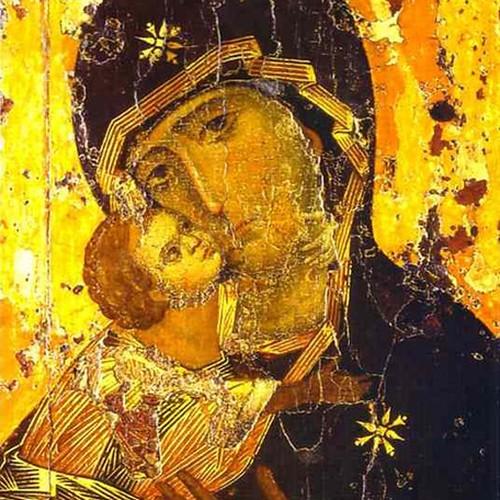
On every icon of the Theotokos, Mary wears three gold stars on her maphorion — one on each shoulder and one on the forehead. Three independent Orthodox sources agree on what they mean: the stars represent that Mary was a virgin before, during, and after the birth of Christ. The three stars are the visual form of the word ἀειπάρθενος. They need no scene, no argument, no text.
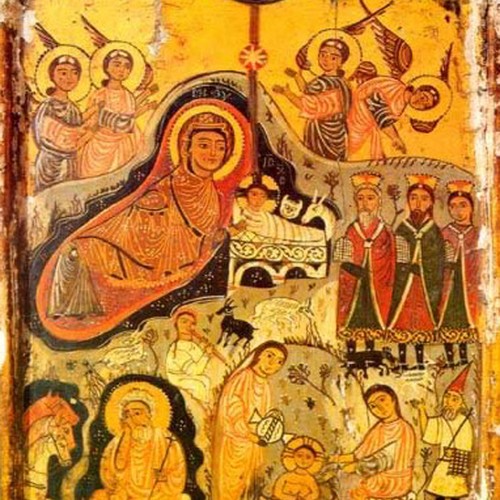
The Nativity icon makes the same point by composition. Mary reclines in rest, showing no suffering of childbirth. Joseph sits apart, his cheek resting on his hand, in doubt — placed at a distance from the Mother and Child. The Child lies swaddled in a stone manger that prefigures the tomb. The composition — formulated as early as the sixth century and standardised by the ninth — asserts a miraculous birth without showing one.
The midwives’ bath is the one element that seems to pull the other way. Two women wash the newborn Jesus at the bottom of the icon. The bath proves He is truly human, but it does not prove a virginal birth. And here is the finding the research turned up: the two women are Salome and her companion from the Protoevangelium, but the test itself — Salome’s finger, the withered hand, the healing — is not pictured. The tradition pictures the witnesses to the virgin birth but not the proof. The proof is left to the hymnography and the text, while the icon asserts the fact by Mary’s repose and Joseph’s exclusion.
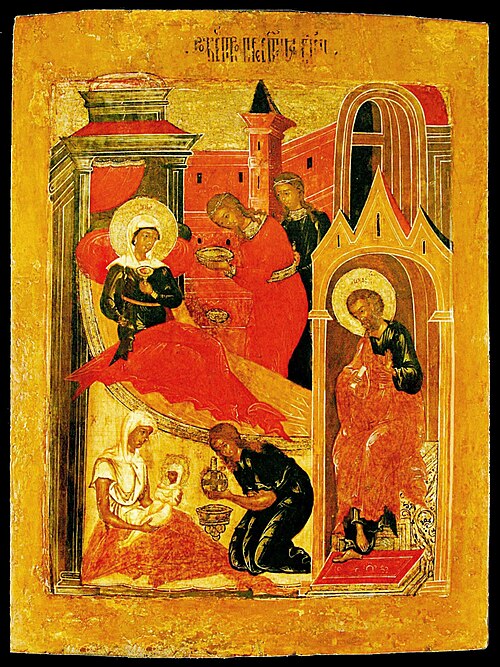
The contrast that proves the point is the icon of the Nativity of the Theotokos — the birth of Mary herself. There Anna reclines after giving birth, midwives bathe the infant Mary, and Joachim stands apart, just as Joseph does in the Nativity of Christ. The same composition serves both births; the difference is the cave against the house, and Joseph’s doubt against Joachim’s delight. The tradition does picture an ordinary birth — for Mary herself. It pointedly does not picture one for her Son.
The absences complete the picture. There is no “Holy Family” icon in the Western sense, and no icon of Mary in labour — the iconographic language for an ordinary birth exists, and is used for Nicholas and Anna and others, and is pointedly not used for Mary. And the closed gate of Ezekiel, preached by the Fathers and sung in the hymns, was never painted. The Fathers preach the gate and the garden in words; the painters never painted them. The doctrine’s visual language is the three stars and the Nativity composition, not the gate.
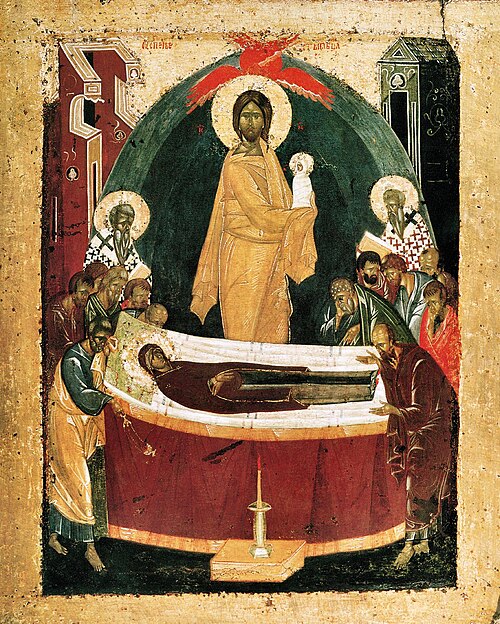
The Dormition icon is the closing image. Christ stands behind His Mother’s bier, holding in His arms an infant in white — her soul, reborn in glory. She once held Him as an infant; now He holds her as an infant. And the feast’s troparion yokes the two mysteries in a single breath: “In giving birth, you preserved your virginity! In falling asleep you did not forsake the world, O Theotokos!”
What the icons prove is that the Church believes the doctrine, and has believed it for a very long time. What they do not prove is that the doctrine is true. A picture of a belief is not an argument for it. The iconography is a witness to the consensus — and the consensus is the question, not the answer.
5. The consensus
The Orthodox case, stated fairly, is this. The doctrine is attested by the second century, confessed by the fifth-century councils, held by the Reformers, and embedded in the liturgy of the whole Church, East and West. The plain-sense reading of “brothers” is the one reading the earliest tradition never held — Lightfoot and Bauckham, evangelical scholars, say so. And the price of the evangelical reading is not nothing: it requires you to believe the Church was wrong, together, for fifteen centuries, about the Mother of her Lord — which is a claim about the Church, not about a verse.
The Reformers are part of that case, and they should be stated plainly. Luther affirmed the doctrine to the end of his life — Christ “was the only Son of Mary, and the Virgin Mary bore no children besides Him” — and his reason was an argument from silence: “We should be satisfied simply to hold that she remained a virgin after the birth of Christ because Scripture does not state or indicate that she later lost her virginity”. Zwingli preached a whole sermon on it in Zürich in September 1522, and his Fidei Ratio of 1531 confesses that Christ’s humanity “was brought forth by preserving her perpetual virginity”. Calvin is the interesting case: on Matthew 1:25 he refuses the Helvidian inference — “no just and well-grounded inference can be drawn from these words of the Evangelist, as to what took place after the birth of Christ” — but on Luke 1:34 he rejects the idea that Mary had taken a vow of perpetual virginity as “unfounded and altogether absurd”, saying she would “have committed treachery by allowing herself to be united to a husband, and would have poured contempt on the holy covenant of marriage”. Calvin is neutral-to-sceptical, not an affirmer. The Second Helvetic Confession of 1566 affirms the doctrine — the eternal Son “was most chastely conceived by the Holy Spirit and born of the ever virgin Mary” — which corrects the easy claim that no Reformed confession affirms it. Westminster (1646) says only that Christ was “conceived by the power of the Holy Ghost, in the womb of the virgin Mary, of her substance”, and says nothing about virginity after the birth; the Belgic Confession (1561) is silent. And the move away, when it came, was by drift and silence, never by confessional repudiation. François Turretin, writing in the 1680s, still affirmed the doctrine — but downgraded it: it is “not expressly declared in Scripture, but is yet piously believed with human faith from the consent of the ancient church”. From dogma to probable pious belief. John Wesley is reported to have still affirmed it into the 1790s. No synod ever decided against it. The doctrine was lost, as the Lutheran scholar Friedrich Heiler put it, by “the spirit of the enlightenment with its lack of understanding of mystery” — by the tightening of sola scriptura into “nothing may be believed that is not expressly in Scripture”, and by the doctrine becoming a marker of Rome, so that Protestants dropped it by association.
But the Reformers holding the doctrine proves nothing. They inherited it and kept it. They did not test it. Luther’s reason is an argument from silence, and silence cuts both ways: Scripture does state that Joseph “knew her not until she had given birth to a son”, it does call Jesus her firstborn, and it does name His brothers and sisters. And by their own principle — Scripture judges tradition, including their own — their acceptance cannot settle the question. The doctrine has to stand on Scripture, or it does not stand.
That price is real, and it should not be minimised. But it is not evidence. It is the same argument in a different form: the Church held it, therefore it is true. The question is whether fifteen centuries of consensus can establish what Scripture does not say — and the answer has to be no. If the Church held a belief for fifteen centuries that turns out to be false, that is evidence the Church can err for a very long time on a widely held belief. That is the point the Orthodox case cannot answer, because its whole case is that the Church cannot err together for that long — and that claim is itself the thing in dispute. It is not in Scripture. Scripture is the test of the Church, not the Church the test of Scripture.
The Orthodox position is caught in its own tension, and it belongs on the record. Basil, the greatest Father who defended the doctrine, admitted it is not load-bearing for the faith: Mary’s virginity “was necessary until the service of the Incarnation, and what happened afterward need not be investigated”. Yet Epiphanius, writing against the Antidicomarianites in the fourth century — a real group who held that Mary “had marital relations after the Savior’s birth” — treated the denial as heresy, not as a tolerable opinion. If the doctrine is not load-bearing, why is its denial heresy?
So the verdict stands. The ever-virginity is not in Scripture. It was never defined by an ecumenical council. Its first full statement is an apocryphon, its earliest patristic defence argues from piety, its strongest patristic argument proves the conception and not what followed, its modern defenders argue the Virgin Birth rather than the doctrine itself, and its confessional history shows a pious opinion held without argument and dropped without a decision. The consensus is real, and it is not enough.
6. What remains
What Scripture does teach stands untouched: the virginal conception, Mary as Theotokos, the true God and true man, her blessedness among women, the uniqueness of the Incarnation. As Sam Storms puts it: “The Virgin Birth alone insured both the full deity and full humanity of Jesus”. None of that is lost. What is lost is a belief the Church added to the text — and the claim that fifteen centuries of agreement can make an addition true.
Sources. Scripture quotations follow the English Standard Version. The μονογενής point rests on Luke 7:12; 8:42; 9:38 and John 1:14; 3:16. The conciliar record: Constantinople II (553), Anathemas 2 and 6 (the Greek acts are lost; the text survives in Latin); the Lateran Synod of 649, Canon 3 (Denzinger 503). The Protoevangelium of James, chs. 19–20 (Walker translation). Origen, Commentary on Matthew X.17 and Contra Celsum II.69; Augustine, De sancta virginitate 4; Chrysostom, Homily 5 on Matthew; Jerome, Against Helvidius 2 and 21 — all in the Ante-Nicene and Nicene and Post-Nicene Fathers. The gate: Ambrose, De institutione virginis VIII.52 (Latin as quoted in Salvador-González, Fenestella II (2021)); Rufinus, Commentary on the Apostles’ Creed §9; Jerome, Letter 48 to Pammachius §21; Origen, Homilies on Ezekiel 14 (Scheck, Ancient Christian Writers 62). The Christological proof: Proclus of Constantinople, Homily 1 §5 (Greek from ACO 1.1.1:103–107; English: Constas, Proclus of Constantinople and the Cult of the Virgin in Late Antiquity, Brill, 2003); Augustine, Tractates on John 121.4; Athanasius, Orations against the Arians II.70; Gregory of Nyssa, On Virginity 19; Leo the Great, Tome to Flavian (449); Ignatius, To the Ephesians 19; Justin Martyr, Dialogue with Trypho 100; Irenaeus, Against Heresies III.21–22; Tertullian, On the Flesh of Christ 23 and On Monogamy 8 (the quotations are reproduced from secondary sources and the ANF text was not re-read in this round; the Helvidian reading of Tertullian is contested; see the text). The moderns: Georges Florovsky, “The Ever-Virgin Mother of God”, in Collected Works III; Kallistos Ware, The Orthodox Way, ch. 4, and The Orthodox Church, Part II; Vladimir Lossky, The Mystical Theology of the Eastern Church, ch. 9; John Meyendorff, Byzantine Theology, Part II, ch. 12; Thomas Hopko, The Orthodox Faith, vol. 1 (the 1972 first-edition passage on the Purification is quoted from a secondary source and was dropped or revised in the current edition). Mary as type of the Church: Augustine, De sancta virginitate 6 and Sermon 192; Ambrose as cited in Lumen Gentium 63. The iconography: the Annunciation icon descriptions of the Byzantine Eparchy of Phoenix, ACROD, and St George, Greenville; OCA, “The Nativity Icon”; Stracke, “The Birth of Christ” (christianiconography.info); Podles, “Rublev’s Nativity”, Touchstone; OrthoChristian, “The Nativity of the Theotokos Icon”; the Dormition icon descriptions of St Sophia, Washington DC, and the Greek Archdiocese of Canada. The Reformers: Luther, Sermons on John (Luther’s Works 22) and That Jesus Christ Was Born a Jew (Luther’s Works 45); Zwingli, A Sermon on the Ever-Virgin Maid Mary (1522) and Fidei Ratio (1531), art. 5; Calvin, Harmony of the Evangelists, on Matthew 1:25 and Luke 1:34; the Second Helvetic Confession (1566), ch. XI; the Westminster Confession (1646), ch. VIII.2; the Belgic Confession (1561), Art. 18; François Turretin, Institutes of Elenctic Theology, Topic 13, Q. 21. The consensus: Sam Storms, “Virgin Birth”; Kevin T. Bauder, “Perpetual Virginity?”, In the Nick of Time, 12 December 2025; J. B. Lightfoot, “The Brethren of the Lord” (1865); Richard Bauckham, Jude and the Relatives of Jesus (the Bauckham conclusion is quoted from a secondary source); Basil of Caesarea, Homily on the Holy Birth of Christ §5 (the attribution was doubted by Garnier in the Maurist edition and is accepted in modern editions); Epiphanius, Panarion 78 (Frank Williams translation, as quoted in secondary sources). The Luther, Zwingli sermon, Turretin, and Epiphanius quotations are reproduced from secondary sources and were not read in the primary volumes in this round. The Wesley affirmation and the Heiler quotation are likewise reported via secondary sources. Full research notes: ~/workspace/research_notes/aeiparthenos-theology-20261124/report.md.
Related reading: What Orthodoxy teaches about the Theotokos · What Orthodoxy teaches about Mary’s children
Researched and drafted with the help of Muse, an AI assistant. Every claim is checked against its sources, and every article is approved by Aris Angelakopoulos before publication.